

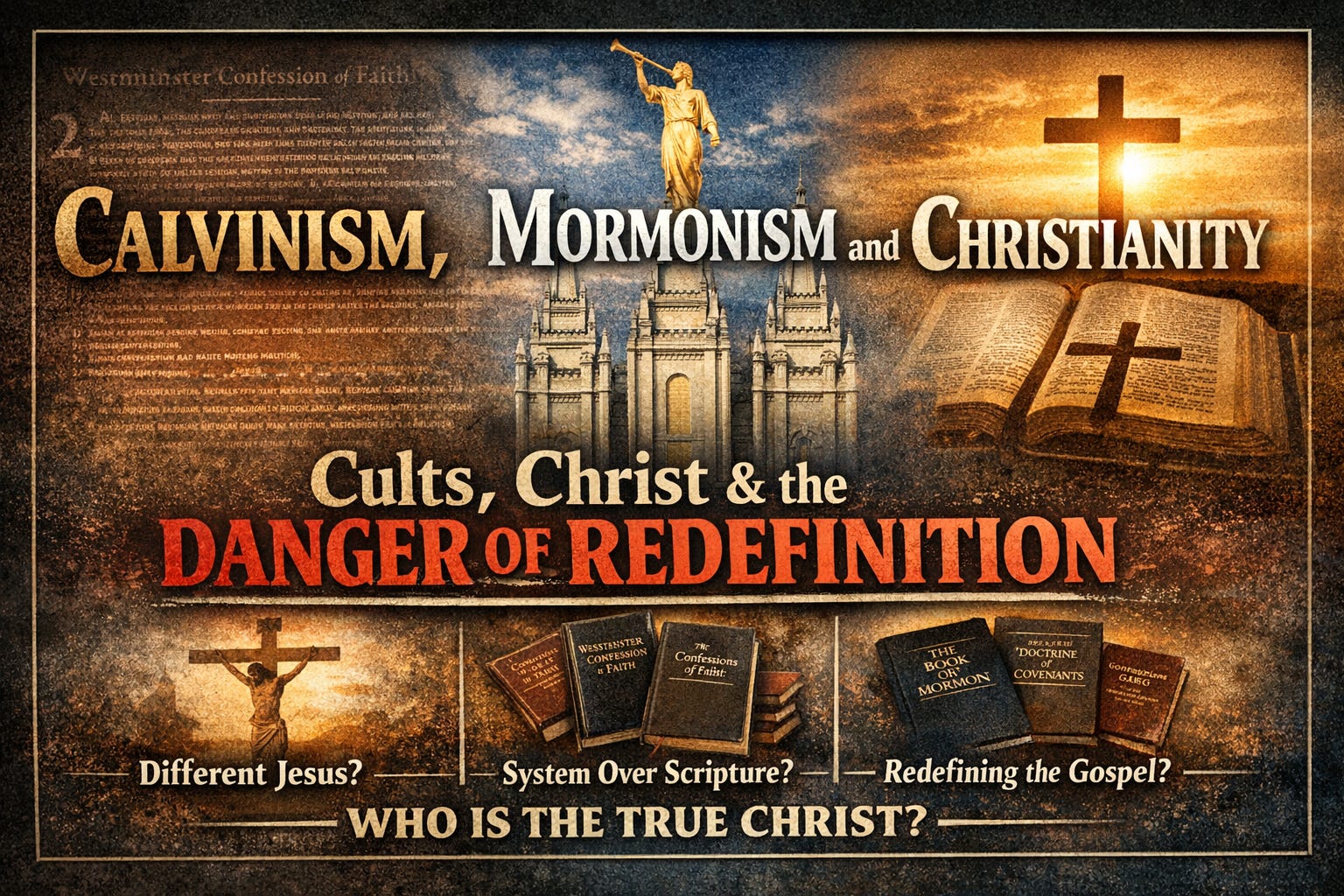
The word cult gets thrown around far too loosely in theological discussions. Sometimes it’s used as nothing more than a rhetorical weapon—meant to shock rather than to clarify. But there are meaningful reasons why certain belief systems have historically been classified as cults, and those reasons deserve careful, honest examination.
In this article, I want to do something specific and deliberate:
Define what Christians typically mean when they use the word cult
Establish historic Christianity as the baseline
Show why Mormonism clearly qualifies as a cult in the classic sense
Examine Calvinism more carefully—not emotionally, but structurally
Ask the most important question of all: Which Jesus is being preached?
This is not an attack piece. It’s an attempt to think clearly about truth, authority, and the gospel.
What Do Christians Mean by “Cult”?
In historic Christian apologetics, a cult is not simply a group that is strict, unpopular, or wrong on secondary doctrines. A group becomes cultic when it systematically replaces or distorts the biblical Christ, the biblical gospel, or the authority of Scripture, even if it continues to use Christian language.
Cult status is determined cumulatively, not by a single error. Common markers include:
A different Jesus (by nature, mission, or saving work)
An authority structure that controls or overrides Scripture
A redefined gospel
Semantic camouflage (using biblical words with altered meanings)
Doctrinal concealment or bait-and-switch methods
Loyalty to a system over correction by Scripture
Not every doctrinal error qualifies. But when several of these are present together, the concern becomes serious.
Historic Christianity as the Baseline
Historic Christianity affirms:
One eternal, uncreated God
Jesus Christ as fully God and fully man
Christ’s atoning death as sufficient and genuinely offered to the world
That God is not the author of sin
That salvation is by grace through faith
That Scripture is the final authority—not a theological system
This framework serves as the control group for comparison.
Mormonism: A Clear Cult Case
Mormonism uses Christian language, but its theology fundamentally redefines God and Christ.
In Mormon doctrine, Jesus is not eternally God in the historic Christian sense. God the Father is not eternally God. Humans can become gods. Jesus belongs to a different ontological category altogether.
Just as important, Mormonism introduces additional binding authorities—extra scriptures and ongoing prophetic revelation—that functionally override the Bible when conflicts arise.
Because Mormonism presents a different Jesus and a different authority structure, it fits the classic Christian definition of a cult without controversy.
Calvinism: Why the Question Is Harder—and Why It Still Matters
Calvinism does not openly deny the Trinity or the deity of Christ. That alone is why it often escapes scrutiny under the cult label. But that does not end the discussion.
The real question is not whether Calvinism uses orthodox language.
The question is whether Calvinism functionally redefines the gospel, the authority of Scripture, and the character and mission of Christ.
Scripture or System?
Calvinism claims sola Scriptura, but in practice Scripture is often interpreted through a rigid theological grid.
Confessions such as Westminster or the 1689 are not merely summaries; they frequently function as interpretive boundaries. Texts are harmonized to the system, rather than the system being corrected by the full weight of Scripture.
Using confessions is not the problem. Subordinating Scripture to a system is.
That is one of the oldest warning signs of cultic structure.
Doctrinal Concealment and “Stealth”
Another serious concern—acknowledged by Calvinist leaders themselves—is the practice of withholding full Calvinist doctrine until after trust, position, or authority has been established.
This is not an accusation; it is an admission.
The pattern is familiar:
Start with shared Christian language
Delay controversial doctrines
Introduce “deeper truths” later
Frame objections as immaturity or resistance to God
Historic Christianity does not require concealment to survive. Truth does not need bait-and-switch tactics.
Semantic Camouflage: Same Words, Different Meanings
One of the most effective methods of theological control is redefining words while keeping them familiar.
In Calvinism, terms such as love, grace, call, world, and gospel are retained—but redefined.
God’s love becomes selective salvific intent
Grace becomes irresistible compulsion
The call of the gospel becomes effectual only for the elect
“World” often collapses into “the elect”
“Good news” becomes good news only for some
This is not accidental. It is how systems protect themselves from contradiction.
A Helpful Resource on Calvinism (Recommended Video)
If you want to see many of these issues discussed more conversationally and with real-world examples, there’s a helpful video from Faith on Fire prompted this article that directly addresses Calvinism and its theological implications:
I don’t agree with everything YouTuber says, and I don’t present his work as a final authority. However, his videos are especially helpful when it comes to identifying and unpacking Calvinist theology, including how certain doctrines are introduced, framed, and defended.
If you’re trying to better understand Calvinism—particularly from a critical, Scripture-focused perspective—his channel is a useful place to explore further. I’ve also got other resources I can share in the future.
The Central Question: Which Jesus?
This is the most important issue.
Calvinism formally affirms:
The deity of Christ
The incarnation
The resurrection
So Calvinism does not present a different Jesus ontologically, the way Mormonism does.
But Calvinism does present a functionally different Jesus.
A Jesus who:
Did not die for all
Does not desire all to be saved
Withholds saving grace from most
Condemns people for inability
Regenerates before faith
Saves apart from belief as a condition
This is not a different Jesus by nature, but a different Jesus by character, mission, and gospel function.
And that distinction matters—but it does not erase the problem.
So Is Calvinism a Cult?
The most accurate answer is also the most careful one.
Mormonism is a cult in the classic Christian sense
Calvinism is not identical to Mormonism
But Calvinism exhibits cult-like behavior at the system level
It functions as an internal distortion—retaining Christian language while reshaping the gospel and the character of Christ from within.
That makes it subtler—and in many ways, more dangerous.
Why This Matters
False religions deceive by replacement.
Calvinism deceives by redefinition.
Both ultimately train believers to trust a system rather than Scripture, and to accept a Christ shaped by theology rather than revealed by the Word of God.
That is not a small issue.
It is the difference between guarding the gospel—and slowly losing it while still using the right words.