

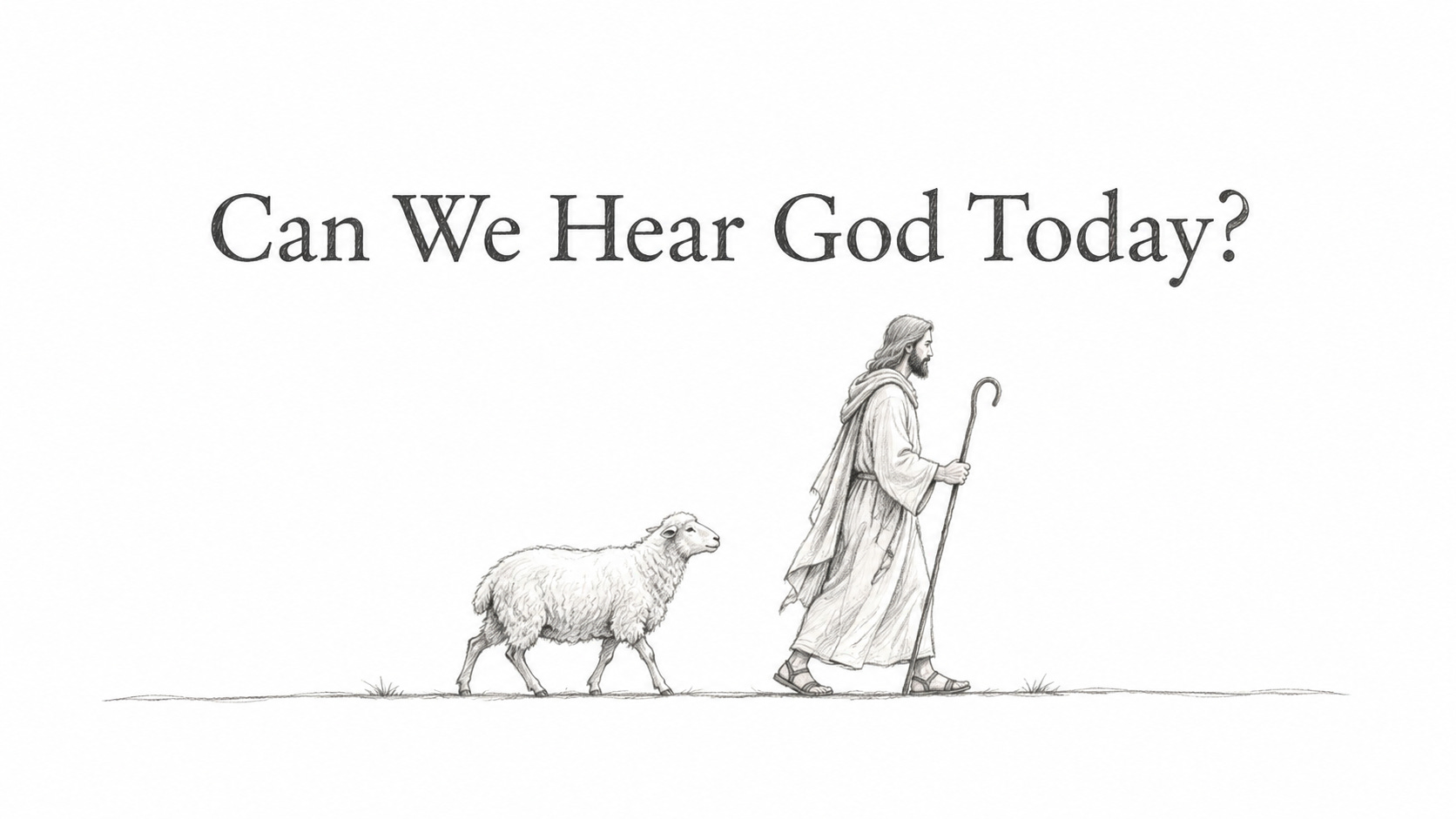
For a long time, I did not think I could hear God’s voice in a real, personal way.
I knew the Bible said that His sheep hear His voice. I had also heard stories about people who said God spoke to them. But I was skeptical. Sometimes I thought there had to be a trick behind it. Maybe someone was trying to get attention, money, or influence. Maybe the story had been exaggerated somewhere along the way.
Because of that, I mostly kept the whole idea at a distance.
The problem was that much of what I thought I knew came through third-hand stories. Someone heard about someone else who supposedly heard from God, and the story sounded fake, so I assumed the whole subject was probably fake too.
Then I began meeting people for myself.
I watched ordinary Christians pray for people and then share things they believed the Lord was showing them. Sometimes the person receiving the word would say it connected with something deeply personal. Sometimes it touched a question they had just been praying about. Sometimes it made them feel seen and loved by God.
That challenged me.
I had always wanted to know the Lord. I had wanted His presence to be real in my life. But hearing God still felt like something that belonged to prophets in the Old Testament or apostles in the New Testament—not something for ordinary Christians today.
Then I had to come back to a simple verse I already knew.
“My sheep hear my voice, and I know them, and they follow me:”
— John 10:27 KJV
Jesus did not say, “My prophets hear my voice.” He said, “My sheep hear my voice.”
That made me start asking a different question.
What if hearing the Lord is not supposed to be strange and unreachable? What if it is part of knowing and following Him?
His Sheep Know His Voice
John 10 gives us a beautiful picture of the relationship between the shepherd and his sheep.
“...he calleth his own sheep by name, and leadeth them out. And when he putteth forth his own sheep, he goeth before them, and the sheep follow him: for they know his voice.”
— John 10:3–4 KJV
The picture is personal.
The shepherd knows the sheep. He calls them by name. He leads them. They learn his voice and follow him.
That does not sound like a distant relationship.
Sometimes we make hearing God sound like something reserved for a tiny group of unusually spiritual people. We think of prophets, apostles, pastors, or people with some special ministry. We put hearing God at such a high level that ordinary Christians may never even try to listen.
But when we read the Bible, we find God communicating with all kinds of people. Kings, judges, shepherds, fathers, mothers, fishermen, and many others encountered Him in different ways. The Bible even records unbelievers receiving dreams from God.
So I began asking myself: if God could speak to people throughout Scripture, why would I assume that His children today should expect a relationship in which He never speaks to them?
The New Testament Does Not Treat This as Unusual
The New Testament also gives us a picture of the Spirit of God working among ordinary believers.
Peter stood up on the day of Pentecost and quoted the prophet Joel:
“And it shall come to pass in the last days, saith God, I will pour out of my Spirit upon all flesh: and your sons and your daughters shall prophesy, and your young men shall see visions, and your old men shall dream dreams: And on my servants and on my handmaidens I will pour out in those days of my Spirit; and they shall prophesy:”
— Acts 2:17–18 KJV
Paul later wrote to the church at Corinth:
“Follow after charity, and desire spiritual gifts, but rather that ye may prophesy.”
— 1 Corinthians 14:1 KJV
Whatever conclusions we reach about every detail of prophecy and spiritual gifts, we cannot simply ignore passages like these. They caused me to look again at assumptions I had carried for years.
I realized that I had often started with my experience and then read the Bible through that experience.
I had not experienced hearing God clearly, so I assumed He probably did not speak that way anymore.
But what if I reversed that?
What if I allowed Scripture to challenge my experience instead?
I Had to Learn
Once I became open to the possibility that the Lord still speaks, I did not suddenly become good at recognizing His voice.
I went to a training where I could practice in what felt like a safe environment. At first, I was terrible at it.
I mean terrible.
I got things wrong. Nothing I shared seemed to connect. I could have easily walked away and decided, “See? I knew this wasn’t real.”
But I kept practicing.
I asked people for honest feedback. I tried to pay attention to what I thought I was hearing. I learned not to treat every thought in my head as automatically coming from God.
Over time, things began to change.
Sometimes I would share something and a person would tell me it was surprisingly accurate. Sometimes it connected with something they had recently been praying about. Sometimes I still missed it.
That distinction became important to me: learning to hear the Lord is not the same thing as claiming that every impression I have is from God.
I am still learning.
That is one reason Scripture matters so much.
Two Small Experiences That Encouraged Me
There were two experiences from that season that especially encouraged me.
The first happened while I was praying for someone. I believed I heard a particular name. I shared it, and the person told me that was the name of a family member in Indonesia. I had never met the person before and had no way of knowing the family member’s name on my own.
That got my attention.
Another experience happened at work.
I was about to send off a quote for more than $400. Before doing it, I had a strong impression that I should call the manufacturer first. I had been asking the Lord to help me hear Him at work and to give me wisdom in practical things, so I decided not to ignore the thought.
I called.
The manufacturer told me I could send the equipment in and they would take care of it for free.
Was that the biggest miracle anyone has ever experienced? No.
But it mattered to me because it made the relationship feel practical. I was beginning to believe that God cared about ordinary parts of my life too—not only church services, Bible studies, or “spiritual” moments.
Experience Is Not the Standard
This is important.
I do not believe we should accept something merely because someone says, “God told me.”
Our experiences do not become Scripture.
Feelings can be wrong. Impressions can be wrong. People can misunderstand things. We can want something so badly that we mistake our own desires for the Lord’s direction.
That is why everything we think we hear should be checked against Scripture.
The written Word of God gives us a standard outside of ourselves.
If something contradicts Scripture, I do not need to wonder whether God told me to do it. God is not going to contradict His Word.
And even when something does not contradict Scripture, that does not mean we should become careless. We can stay humble. We can ask questions. We can seek confirmation. We can invite feedback. We can admit when we were wrong.
Later in this series, I want to spend much more time on how to test what we think we hear and what to do when we get something wrong.
But before we get there, I think we have to settle the first question:
Can we hear God today?
I believe the answer is yes.
Not because I think every strange spiritual story is true.
Not because every person who says “God told me” is correct.
And not because I believe Christians become infallible when they pray.
I believe it because Scripture gives us a picture of a God who communicates with people, a Shepherd whose sheep know His voice, and a Spirit poured out upon His people.
My own experiences did not create that belief. They caused me to go back and look at the Bible again.
And once I did, I realized how much I had assumed.
Start With the Shepherd
If you have never thought you could hear the Lord, I would not start by trying to become impressive or prophetic.
Start with Jesus.
Be His sheep.
Spend time with Him. Read His Word. Pray. Ask Him questions. Learn His character. Follow what He has already made clear in Scripture.
And then begin making room to listen.
You do not have to pretend you heard something when you did not.
You do not have to make something happen.
You can simply begin with a prayer like:
Lord, I want to know You. Help me recognize Your voice and follow You. Keep me grounded in Your Word, and teach me to hear You clearly.
For years, hearing God felt distant to me.
Now I am amazed that the God who spoke to people throughout Scripture would care enough to lead, teach, and speak to His children today.
I am still learning.
But I want to keep listening.
Next in the series: How to Hear God’s Voice — practical ways to begin listening, learning, testing, and growing without pretending that every thought is from God.