

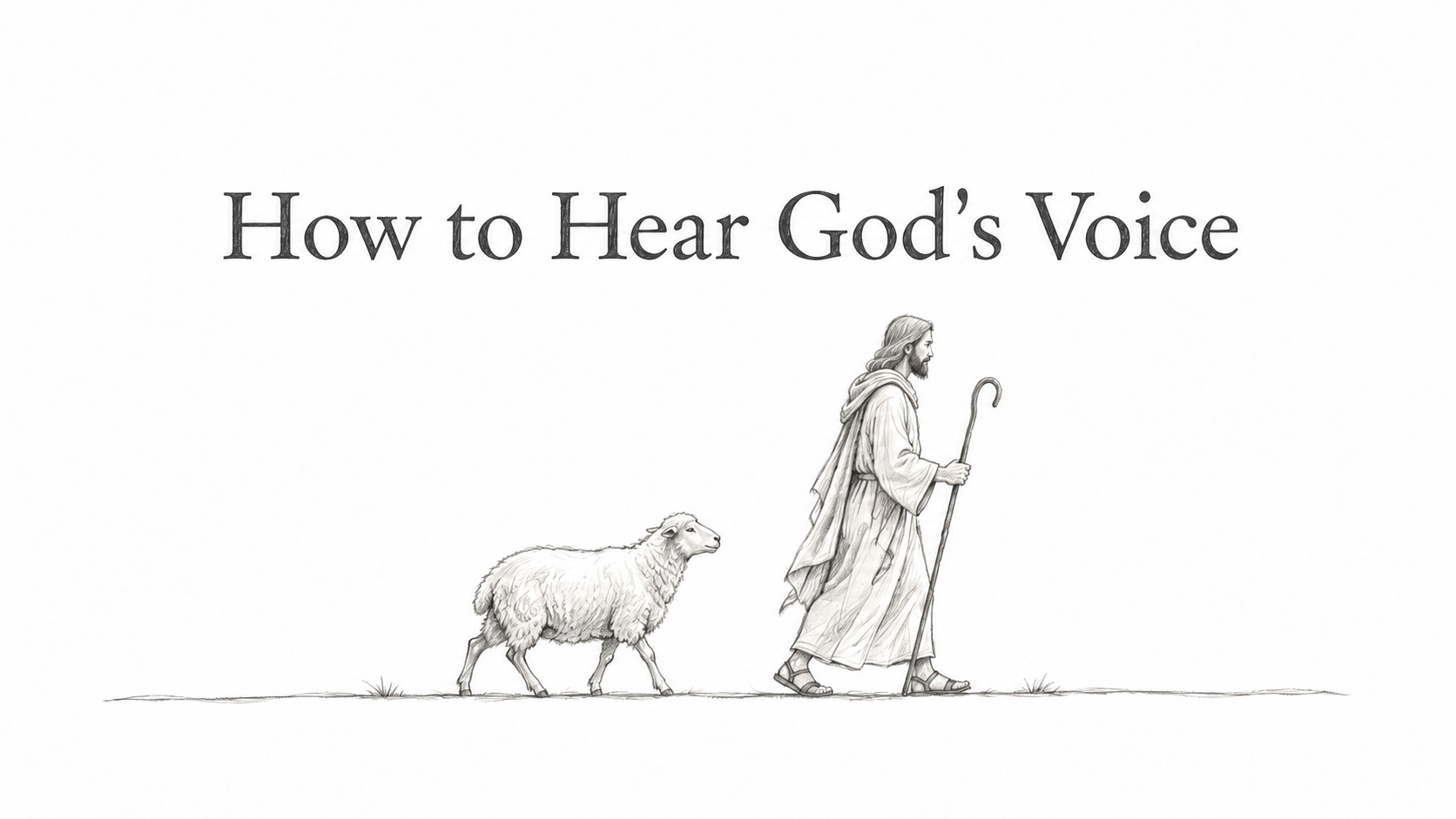
If Jesus said, “My sheep hear my voice,” then one of the next questions is obvious:
How do we actually learn to hear Him?
That was a question I had to work through myself.
For a long time, I thought hearing God was either something mysterious that happened to especially spiritual people or something people were making up. Once I became convinced from Scripture that the Lord still speaks and that His people can hear Him, I had another problem.
I did not know what I was doing.
I did not suddenly recognize every thought, impression, picture, or feeling perfectly. I had to learn.
And I am still learning.
I think that is an important place to begin, because sometimes we make hearing God harder by expecting ourselves to be experts before we have even started.
Learning Takes Time
Think about a baby learning to walk.
No one watches a baby fall down and says, “Well, I guess walking isn’t real.”
No one gets angry and slaps the baby because the baby took three steps and fell.
We cheer.
We help the baby back up.
We create a safe place for the baby to learn. Over time, those shaky steps become normal walking.
Learning to recognize the Lord’s voice can involve that same kind of growth.
Learning takes time, effort, safety, and risk.
There will be moments when you think you heard something clearly and later realize you were wrong. There may also be moments when you step out nervously and discover that what you sensed was surprisingly accurate.
Both can teach you something.
Instead of becoming proud when you get something right or crushed when you get something wrong, learn from both.
Ask yourself:
What did this feel like when I believed the Lord was speaking?
Was it consistent with Scripture?
Did I rush?
Was I trying too hard to make something happen?
Did fear affect what I thought I heard?
Was there confirmation afterward?
Growth usually happens one step at a time.
Start With Relationship, Not Performance
The goal is not to become impressive.
The goal is to know Jesus.
That changes the whole atmosphere of learning to hear Him.
You do not have to sit down and force yourself to receive some spectacular revelation. You can simply spend time with the Lord.
Find somewhere quiet.
Sit in a chair. Go outside. Put on worship music if that helps you focus. Read the Bible. Worship Him. Thank Him. Slow down.
Then stay there for a little while.
A lot of our prayer can become one-directional. We bring God our list. We tell Him everything that is wrong. We ask Him to fix it all. Then we get up and leave.
And God is left standing there saying, “I had an answer for you.”
What would happen if we also made room to listen?
Prayer is relationship.
Sometimes the most practical first step in learning to hear God is simply to stop talking for a moment and wait before Him.
Ask the Lord Questions
One of the practices that helped me was asking the Lord questions and then waiting.
They do not have to be complicated questions.
You might ask:
Father, what’s on Your heart?
Father, what do You want to tell me?
Father, what do You love about me?
Father, where would You like me to read in Scripture today?
Father, who should I pray for today?
Father, what should I pray for that person?
Father, what do You want me to do with my time right now?
Father, what do You want to show me about Yourself today?
Then wait.
Do not panic if nothing dramatic happens.
You are not trying to manufacture an answer.
You are learning to listen.
Scripture Shows People Asking Specific Questions
This idea of asking God for direction is not foreign to Scripture.
David repeatedly inquired of the Lord and received specific direction. At times he went back and asked again for clarification.
Samuel had to learn to recognize when God was calling him.
God gave Moses detailed instructions.
Jesus gave His disciples specific directions.
The early church prayed about specific situations and saw specific answers.
These examples encouraged me to stop thinking that asking God questions was somehow inappropriate.
We should absolutely seek wisdom in Scripture. We should use the minds God gave us. We should receive wise counsel.
But we can also ask the Lord for direction.
And then we can listen.
Pay Attention to How the Answer Comes
One thing that surprised me as I began learning is that hearing God does not always mean hearing an audible voice.
You might have a thought come strongly to mind.
You might picture something.
You might have an impression or a sense of knowing.
You might be reminded of a Scripture.
You might suddenly think of a person you need to pray for or contact.
The point is not to become fascinated with the method. The point is to pay attention to the Lord.
We will look much more closely at the different ways God communicates in the next article in this series.
For now, simply become willing to notice.
Ask Follow-Up Questions
This was another important lesson for me.
Sometimes we sense something and immediately try to interpret it ourselves.
Suppose while praying you picture a mountain.
You could immediately decide what the mountain means.
Or you could ask:
Lord, what does the mountain mean?
Maybe another thought comes. Maybe the picture develops. Maybe you are reminded of a Scripture. Maybe nothing else happens.
The point is that you do not have to rush to invent an interpretation.
Keep talking with the Lord.
Ask follow-up questions.
Relationship involves conversation.
Start Small
When you are learning, I would not recommend basing enormous life decisions on a single impression you are not sure about.
Start small.
Ask the Lord who you could encourage today.
Ask if there is someone you should call.
Ask what you should pray about for a friend.
Ask Him to draw your attention to something in Scripture.
Then pay attention to what happens.
As you learn, you can look back and recognize patterns.
This is much healthier than receiving one impression and immediately deciding to quit your job, move across the country, marry someone, or make another major life change because “God told me.”
Learning requires humility.
There is nothing wrong with saying:
“I think the Lord may be leading me this way, but I’m still praying about it.”
That is very different from using “God told me” to shut down every question.
Practice in a Safe Environment
I have benefited from being around other believers who are also learning.
A healthy environment gives people room to try without pretending they are infallible.
You can pray together, ask the Lord questions, share what you think you are hearing, and receive honest feedback.
If you share something with another person, humility matters.
Instead of approaching someone as though you have descended from heaven with an unquestionable message, you can simply say something like:
“I’ve been learning to hear the Lord, and while I was praying I had this thought. Does that mean anything to you?”
That gives the other person room to say yes, no, maybe, or I don’t know.
You are serving them, not controlling them.
You are learning, not performing.
Let Love Shape What You Share
This matters especially when you believe you have sensed something about another person.
It is easy to notice people’s problems.
Maybe you believe you sense anger, fear, depression, addiction, bitterness, or another struggle.
But simply identifying someone’s problem is not necessarily the most loving thing you can do.
Ask the Lord another question:
What is Your heart for this person?
How can I encourage them?
How can I help build them up?
How can I point them toward Jesus?
There is a proper place for correction, but when we are learning, humility, love, encouragement, and compassion are essential.
Paul wrote:
“But he that prophesieth speaketh unto men to edification, and exhortation, and comfort.”
— 1 Corinthians 14:3 KJV
That gives us a helpful picture of the heart behind ministering to other people.
Keep Scripture at the Center
Learning to listen to the Lord should never move us away from Scripture.
It should drive us deeper into it.
If I believe I am hearing something that contradicts the written Word of God, I have a problem with what I think I heard—not with the Bible.
Sometimes, though, what we hear may challenge something false we believe about ourselves.
Maybe you have spent years believing that your sin is too great for God to forgive. Then while praying, you keep being reminded that you are forgiven in Christ.
You can test that against Scripture:
“In whom we have redemption through his blood, the forgiveness of sins, according to the riches of his grace; Wherein he hath abounded toward us in all wisdom and prudence;”
— Ephesians 1:7–8 KJV
And again:
“Who hath delivered us from the power of darkness, and hath translated us into the kingdom of his dear Son: In whom we have redemption through his blood, even the forgiveness of sins:”
— Colossians 1:13–14 KJV
Scripture helps us distinguish between something that merely challenges our current thinking and something that actually contradicts God.
What About Discernment?
This is where people often become nervous.
How do I know whether something came from God, my own thoughts, fear, imagination, or something else?
That is an important question, and it deserves more than a paragraph.
The Bible tells us not to believe every spirit, but to test the spirits. It also gives us objective truth about Jesus Christ against which spiritual claims must be tested.
So learning to hear God should never mean becoming gullible.
We can listen and test.
We can be open and discerning.
We can have faith without pretending that we cannot make mistakes.
We will deal with that much more fully later in this series.
Take the Next Step
At some point, learning requires taking a step.
You can read about hearing God forever without actually making room to listen.
So start small.
Spend time with Jesus.
Ask a question.
Wait.
Pay attention.
Write down what comes to mind.
Check it against Scripture.
If it involves another person, approach them humbly.
Ask for feedback.
Then learn from what happened.
You may get something wrong.
Learn from it.
You may get something right.
Stay humble and learn from that too.
Then take another step.
The purpose of all of this is not to become someone who can say, “Look how spiritual I am.”
It is to know the Lord more deeply, follow Him more closely, and love people more faithfully.
Learning takes time.
But children grow by walking.
And sheep learn the voice of their Shepherd by staying close enough to follow Him.
Next in the series: The Many Ways God Speaks — looking at the different ways people received direction, revelation, pictures, dreams, impressions, and other forms of communication throughout Scripture.