

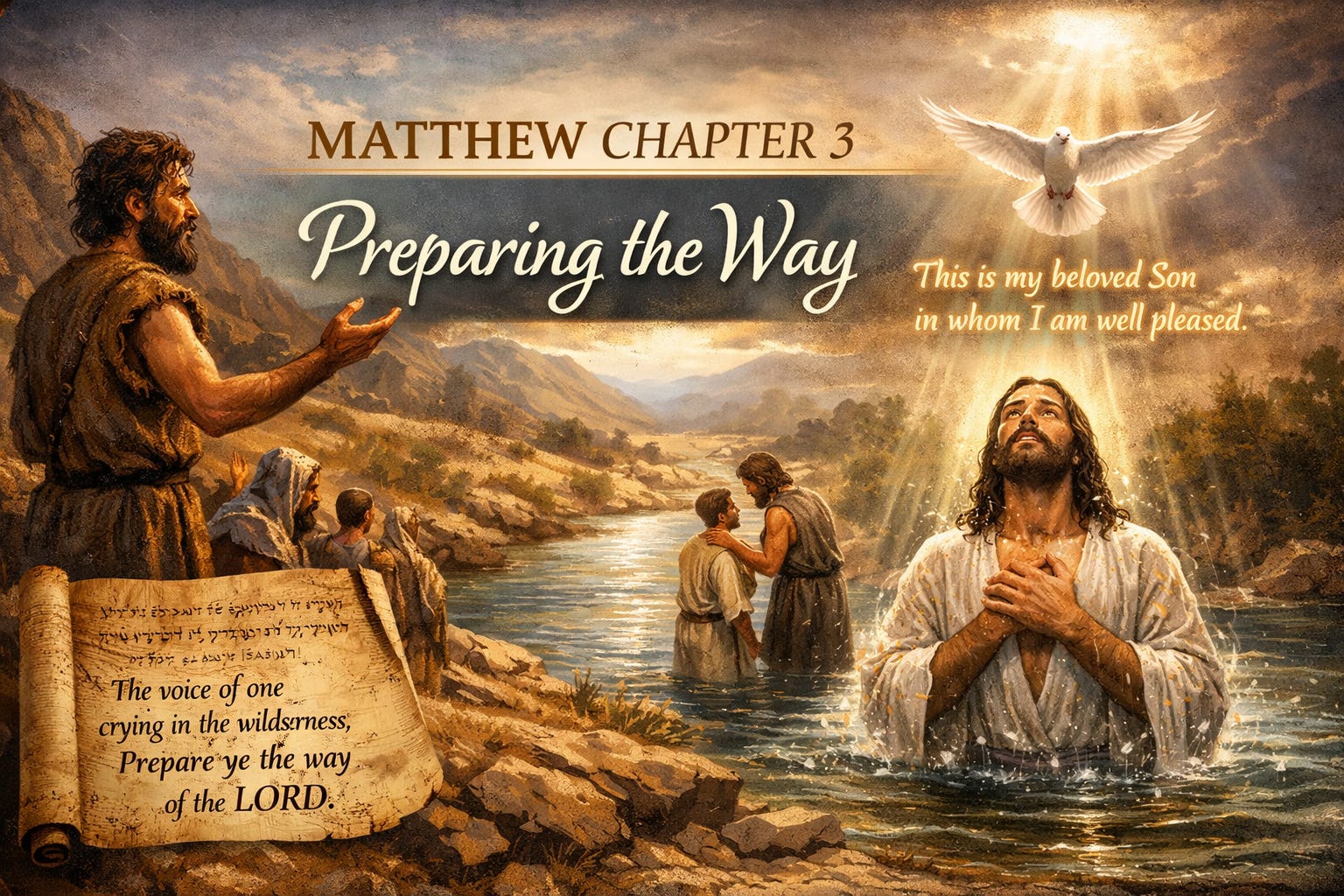
Each week, we’ve been gathering to slowly read through the New Testament together, one chapter at a time. It’s been simple, unhurried, and honestly really life-giving.
My goal for this study is straightforward:
to increase my faith,
to increase my belief, and
to walk away looking more like Jesus.
This past week, we read Matthew chapter 3, and there was so much packed into it that felt worth writing down—not just for me to remember later, but in case it helps someone else walking through the same chapter.
John in the Wilderness
Matthew 3 opens with John the Baptist preaching in the wilderness. That immediately raised questions for us.
Why the wilderness?
How did John get there?
How did he even know this was what he was called to do?
To help answer that, we turned to Luke chapter 1, where John’s calling is spoken about before he is even born:
“For he shall be great in the sight of the Lord… and he shall be filled with the Holy Ghost, even from his mother’s womb.” (Luke 1:15, KJV)
Later in that same passage, it says John would go “in the spirit and power of Elias” to make ready a people prepared for the Lord. That sent us back to the Old Testament—especially Isaiah and Malachi—where we see prophecies about one who would come to prepare the way.
John wasn’t improvising. He was stepping into something God had already spoken.
“Repent Ye”
John’s message is simple and direct:
“Repent ye: for the kingdom of heaven is at hand.” (Matthew 3:2, KJV)
Repent here means change your mind. The kingdom of heaven isn’t distant or theoretical—it’s right here. John is calling people to turn, to wake up, to prepare their hearts because the King is arriving.
That’s what preparing the way looks like: not fixing the road, but turning hearts.
Faith Can’t Be Inherited
One of the most striking moments in the chapter is when John addresses those who trusted in their lineage:
“Think not to say within yourselves, We have Abraham to our father…” (Matthew 3:9, KJV)
John makes it clear: faith is not inherited. God doesn’t need family trees—He can raise children of Abraham from stones if He wants.
That really hits home for many around where I live. Growing up around Christianity, or having Christian parents, doesn’t replace personal faith. Each person must believe, trust, and follow the Lord for themselves.
John’s call is clear: bring forth good fruit.
“He Must Increase”
John also knows exactly who he is—and who he isn’t.
He says he isn’t even worthy to untie the shoes of the One coming after him. John baptizes with water, but Jesus will baptize with the Holy Ghost and with fire.
John never points people to himself. He consistently points them to Jesus.
That alone is a powerful example of humility and obedience.
Why Was Jesus Baptized?
When Jesus comes to be baptized, it raises another big question: Why?
John hesitates—but Jesus answers:
“Suffer it to be so now: for thus it becometh us to fulfil all righteousness.” (Matthew 3:15, KJV)
The word suffer here doesn’t mean pain or torment. It means permit. Allow this. Bear with it.
Jesus is choosing obedience. He’s stepping into something purposeful, even if it’s not immediately obvious.
Both John and Jesus obey—and then something incredible happens.
Heaven Speaks
After Jesus comes up out of the water, the heavens open.
The Spirit of God descends like a dove and lighting upon him. One person in our study noticed that phrase and said, “I don’t remember reading it that way.” She was right—some other translations completely remove it.
We weren’t there to debate translations, but it was meaningful that she noticed. It reminded us why we were reading in the King James Bible.
Then a voice comes from heaven:
“This is my beloved Son, in whom I am well pleased.” (Matthew 3:17, KJV)
God Himself speaks—publicly affirming who Jesus is.
That moment strengthens faith. It confirms identity. It removes doubt.
Walking Away Changed
As I sit with Matthew 3, a few things stand out clearly to me:
God prepares people to do the thing He’s called them to do.
Obedience often comes before full understanding.
True servants point away from themselves and toward Jesus.
The kingdom of heaven is not far off—it is near.
Most of all, this chapter makes me want to listen, obey, and follow—even when I don’t see the full picture yet.
If John could obey the call placed on his life, and if Jesus Himself walked in obedience “to fulfil all righteousness,” then my desire is to walk the same way—to hear the Lord, trust Him, and slowly grow into looking more like Jesus.
If you’re reading along with us, or just opening Matthew 3 on your own this week, I hope this chapter strengthens your faith the way it strengthened mine.