

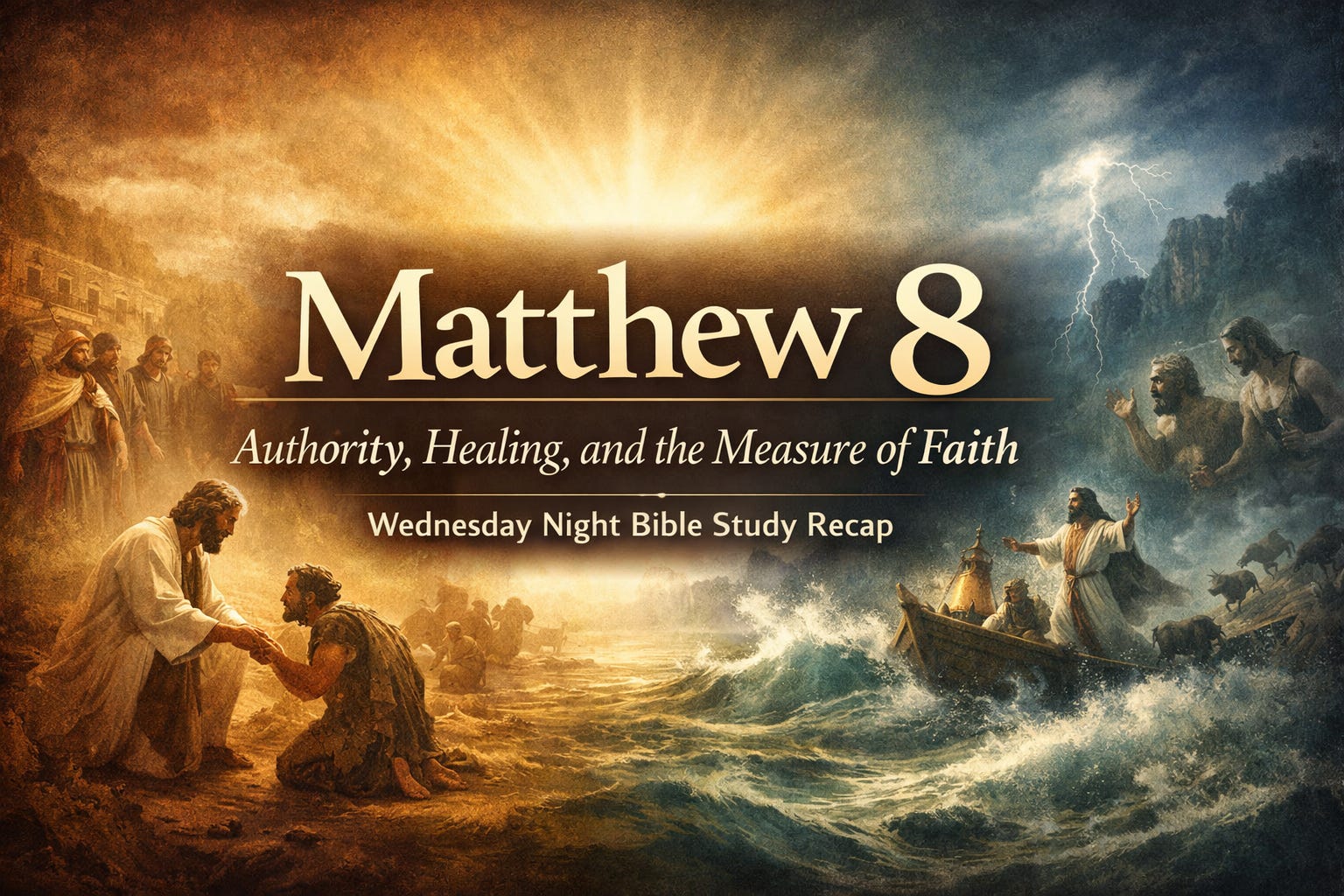
This week we walked through Matthew 8, and what we encountered was a chapter filled with authority, action, and spiritual contrast.
Jesus heals in multiple ways.
Jesus responds to different kinds of faith.
Jesus receives worship without hesitation.
Jesus commands storms.
Jesus casts out devils.
Jesus challenges comfort and exposes hesitation.
Matthew 8 does not merely describe miracles. It reveals who Jesus is — and it confronts what we truly believe about Him.
A Reminder of Our Wednesday Night Pattern
As we study Scripture together, we consistently ask three intentional questions:
Belief — How can I increase my belief about who Jesus truly is?
Faith — How can I strengthen my trust in what He says and what He does?
Walk — How can I leave this study and walk more like Jesus in real life?
This keeps us from reducing Bible study to information alone. The goal is transformation — belief shaping faith, and faith shaping action.
1. The Leper — The Question of Willingness
“And, behold, there came a leper and worshipped him, saying, Lord, if thou wilt, thou canst make me clean.
And Jesus put forth his hand, and touched him, saying, I will; be thou clean.”
— Matthew 8:2–3 (KJV)
The chapter opens with worship. A leper — someone ceremonially unclean and socially rejected — approaches Jesus and worships Him. Jesus does not correct him. He receives the worship.
The leper does not question Jesus’ ability. He questions His willingness.
“If thou wilt…”
Jesus answers directly:
“I will.”
And the cleansing is immediate.
It is also beautiful how Jesus sends the leper to the priests to testify about the miracle. He is not supposed to speak to anyone else about what happened.
Belief
This strengthens our belief in the character of Christ. He is not hesitant. Healing is not extracted from Him; it flows from His compassion.
Faith
Many believers struggle more with God’s willingness than His power. This passage clarifies that Jesus’ will aligns with restoration. We can move in faith that it is God’s will to heal.
Walk
Jesus touched someone others avoided. To walk like Jesus means moving toward brokenness rather than retreating from it. It means praying boldly in faith, because that’s what Jesus would do.
2. The Centurion — Authority Recognized
“Speak the word only, and my servant shall be healed.”
— Matthew 8:8
A Roman centurion approaches Jesus on behalf of his servant. Though he stands outside Israel, he demonstrates remarkable spiritual insight.
He understands authority because he lives under it. When he commands, others obey. He recognizes that Jesus commands sickness in the same way.
Jesus responds with a striking statement:
“I have not found so great faith, no, not in Israel.” (v.10)
Belief
Jesus’ authority is not limited by distance. His word carries power regardless of location.
Faith
The centurion believed before evidence appeared. His confidence rested in who Jesus was, not in what he could see.
“As thou hast believed, so be it done unto thee.”
Belief and outcome are closely connected.
Walk
We are called to intercede for others and to trust the authority of Christ. Our confidence must be rooted in His word, not in our own ability. We can walk in that belief.
3. Peter’s Mother-in-Law — Compassion That Initiates
“And he touched her hand, and the fever left her.”
— Matthew 8:15
There is no recorded request here. No public declaration of faith. Jesus simply sees her condition and responds.
He touches her.
She is healed.
She rises and serves.
Belief
Jesus does not always wait to be asked. His compassion is attentive and intentional. He healed without her initial request.
Faith
We can boldly have faith to lay hands on the sick, and they will recover.
Walk
To walk like Jesus is to notice suffering and act. Restoration should motivate us to lay hands on the sick, because it’s what Jesus would do.
4. Fulfillment of Prophecy — The Scope of His Work
“He cast out the spirits with his word, and healed all that were sick…
Himself took our infirmities, and bare our sicknesses.”
— Matthew 8:16–17
Matthew deliberately connects these miracles to Isaiah’s prophecy. These acts were not isolated events. They were fulfillment.
Jesus bore infirmities.
He carried sicknesses.
He healed all that were sick
Belief
Christ’s redemptive work addresses both spiritual and physical brokenness. Jesus healed all that were sick.
Faith
Since He bore our infirmities, then healing aligns with His mission. Since He healed all that were sick, we can have faith that this is what He would do.
Walk
We continue to pray for healing and deliverance because we follow One who demonstrated both consistently.
5. The Cost of Discipleship — Following Without Conditions
In the middle of powerful miracles, Matthew inserts a serious moment about commitment.
A scribe confidently declares that he will follow Jesus anywhere. Jesus responds:
“The Son of man hath not where to lay his head.” (v.20)
He clarifies the cost. Following Him does not guarantee comfort or security.
Another disciple wants to delay obedience in order to bury his father. Jesus answers:
“Follow me; and let the dead bury their dead.” (v.22)
Allegiance to Christ must come first. Delayed obedience often becomes disguised disobedience.
Belief
Discipleship is not built on convenience. It requires surrender and sacrifice.
Faith
True faith is demonstrated in immediate obedience, not verbal enthusiasm.
Walk
To walk like Jesus means embracing eternal priorities over temporary security.
6. The Storm — Faith Tested in Chaos
“Why are ye fearful, O ye of little faith?”
— Matthew 8:26
A violent storm rises. The disciples panic. Jesus sleeps.
Their fear exposes the limits of their faith. His calm reveals the depth of His authority.
When He rebukes the wind and sea, creation responds instantly.
Belief
Jesus possesses authority over the natural world itself.
Faith
Storms test what we claim to believe. Fear often reveals where trust remains shallow. We can walk in faith to overcome fear and trust Him in the storm. We can rest in the middle of storms even if the waves are crashing into our boat.
Walk
Walking like Jesus includes stability in chaos. It means trusting His authority even before circumstances change. It means resting peacefully during storms, and then waking up and calming them.
7. The Demoniacs — Deliverance and Its Consequences
Two possessed men confront Jesus. The demons recognize Him immediately:
“Jesus, thou Son of God…”
Even darkness acknowledges His authority.
He speaks one word:
“Go.”
Deliverance happens instantly.
Yet the city asks Him to leave.
Freedom disrupted their comfort. Transformation cost something.
Belief
Jesus’ authority extends fully into the spiritual realm.
Faith
Obedience does not guarantee approval. Deliverance may challenge economic or social stability. We can have faith to cast out demons because that is what Jesus did.
Walk
We pursue freedom for others regardless of how it is received. Faithfulness, not applause, measures success. Jesus set people free from the power of evil, and He is our example. We set captives free.
The Consistent Contrast
Throughout Matthew 8, faith and hesitation are placed side by side.
The leper trusts His will.
The centurion trusts His authority.
The disciples panic in the storm.
A scribe hesitates at sacrifice.
An entire city rejects deliverance.
Reactions vary.
Jesus does not.
He heals without hesitation.
He commands with confidence.
He fulfills prophecy with precision.
He calls for deeper faith and greater commitment.
What stands out most is not only that Jesus heals — it is how consistently He heals.
He heals someone who asks for himself.
He heals through intercession.
He heals someone without a recorded request.
He heals from a distance.
He heals with a touch.
He heals with a word.
The circumstances change.
His willingness does not.
Beyond healing, He calms storms and casts out demons. He demonstrates authority over sickness, nature, and the spiritual realm. Nothing in this chapter appears outside His authority or ability.
Final Reflection
Matthew 8 does not simply display miracles. It confronts us with a question:
What do I truly believe about Jesus?
Do I believe He is willing to act?
Do I believe His word carries authority?
Do I trust Him in chaos?
Am I prepared to follow without comfort?
Will I pursue freedom for others even if it disrupts normal life?
Belief shapes faith.
Faith shapes action.
Action reveals who we are becoming.
This chapter suggests something deeper:
Jesus is not merely displaying power for observation. He is modeling a way of life.
He heals consistently because it is His will to heal.
He speaks to storms because He has authority.
He casts out demons because freedom aligns with the kingdom of God.
If He is our example, then He is not only revealing who He is — He is inviting us to grow into that likeness.
The invitation of Matthew 8 is not admiration from a distance.
It is transformation through imitation.