

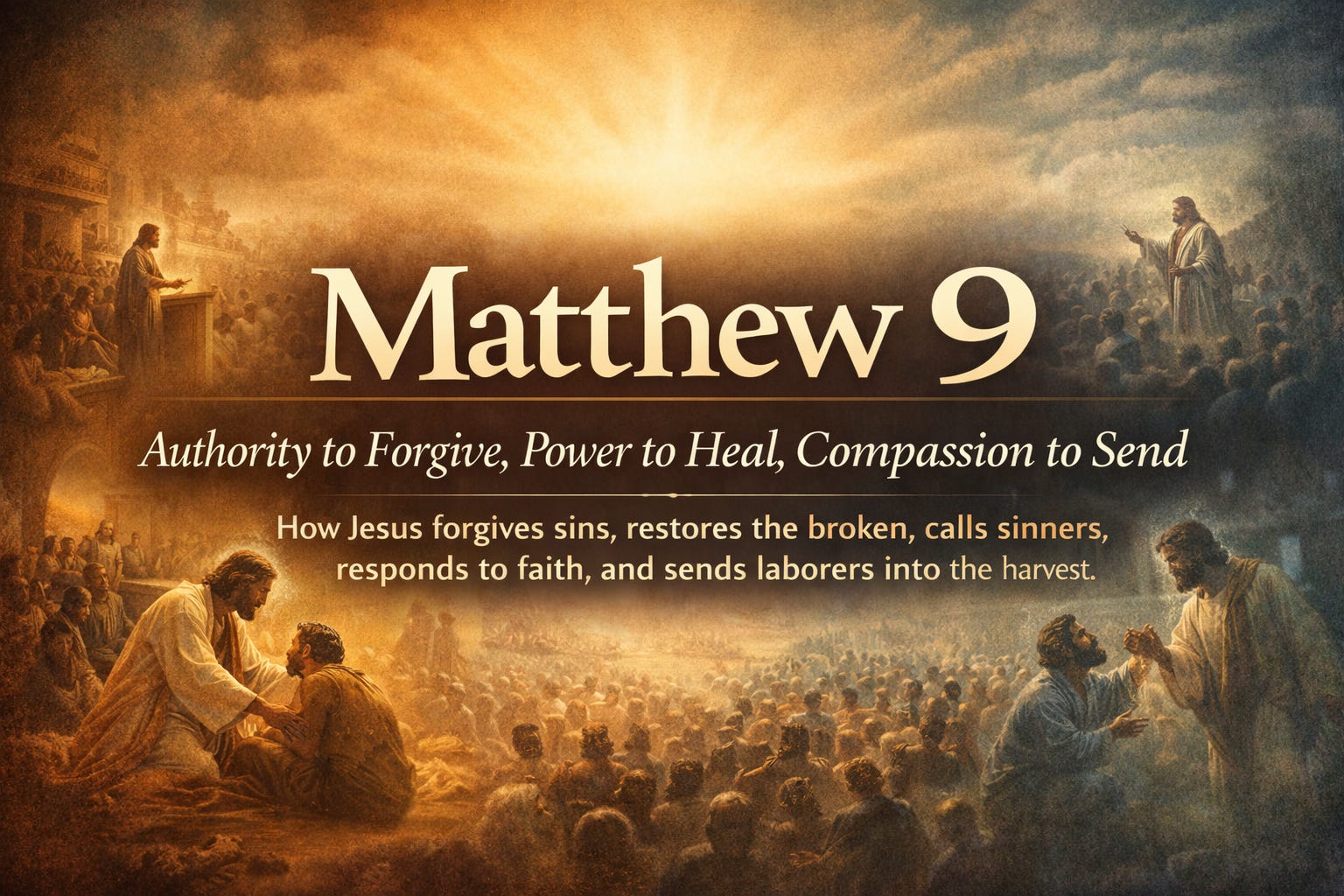
This week we walked through Matthew 9, and what we encountered was a chapter overflowing with authority, mercy, healing, and compassion.
Jesus forgives sins.
Jesus heals bodies.
Jesus calls sinners.
Jesus responds to faith.
Jesus challenges religious thinking.
Jesus is moved with compassion.
Matthew 9 does not simply continue the miracles of Matthew 8. It deepens them. It reveals not only what Jesus can do — but who He is.
A Reminder of Our Wednesday Night Pattern
As we study Scripture together, we ask three intentional questions:
Belief — How can I increase my belief about who Jesus truly is?
Faith — How can I strengthen my trust in what He says and what He does?
Walk — How can I leave this study and walk more like Jesus in real life?
The goal is not information. The goal is transformation.
1. The Paralytic — Authority to Forgive
“Son, be of good cheer; thy sins be forgiven thee.”
— Matthew 9:2 (KJV)
A man sick of the palsy is brought to Jesus by his friends. Scripture says Jesus saw their faith. Before He heals the man’s body, He forgives his sins.
The scribes immediately accuse Him of blasphemy — but they only think it in their hearts. And Jesus knows their thoughts.
That alone reveals something profound.
Belief
Jesus has authority on earth to forgive sins.
Jesus knows the thoughts and intentions of the heart.
He proves His authority by healing the man physically:
“Arise, take up thy bed, and go unto thine house.”
And the man rises.
Faith
We can bring people to Jesus — just like the friends did.
Faith is not only personal; it can be intercessory.
If Jesus forgave then, He forgives now.
Walk
Encourage people the way Jesus did: “Be of good cheer.”
Bring others to Christ.
Believe that forgiveness and healing are both within His authority and available today.
2. Matthew Called — Mercy Over Sacrifice
“Follow me. And he arose, and followed him.”
— Matthew 9:9
Jesus calls Matthew, a tax collector. Then He sits and eats with publicans and sinners.
The Pharisees criticize Him.
Jesus answers:
“They that be whole need not a physician, but they that are sick…
For I am not come to call the righteous, but sinners to repentance.” (v.12–13)
Jesus clarifies His mission.
Belief
Jesus loves sinners.
He does not excuse sin — He calls sinners to repentance.
He values mercy over empty religious performance.
Faith
We can trust that Jesus seeks the broken.
We can have faith to sit with sinners without becoming like them — and to call them to repentance.
Walk
Have mercy.
Call sinners to repentance.
Be willing to be misunderstood if it means reaching the lost.
3. New Wine — A New Container
When questioned about fasting, Jesus speaks of the bridegroom and then gives two illustrations:
New cloth cannot patch old garments.
New wine cannot be poured into old bottles.
The point is clear: what Jesus is bringing cannot be contained within old religious structures.
Belief
The kingdom of God is not merely an adjustment to old systems. It is new life.
Faith
God requires new containers for what He is doing.
Walk
Be willing to change.
Be willing to become a new vessel for what God wants to pour out.
Call people to the new life in Christ.
4. The Ruler’s Daughter & The Woman with the Issue of Blood
A ruler worships Jesus and asks Him to lay hands on his dead daughter.
Jesus rises and goes.
On the way, a woman who has suffered for twelve years touches the hem of His garment.
She says within herself:
“If I may but touch his garment, I shall be whole.”
Jesus responds:
“Daughter, be of good comfort; thy faith hath made thee whole.” (v.22)
Notice something beautiful:
In verse 2, Jesus calls the paralytic “Son.”
In verse 22, He calls her “Daughter.”
There is tenderness in His authority.
Belief
Jesus is worthy of worship.
Jesus responds to faith.
Jesus sees what people say within themselves.
Faith
Faith is not passive.
The ruler asked and the woman pressed through the crowd.
Faith reaches.
Faith acts.
Jesus then arrives at the ruler’s house. He takes the girl by the hand — and she rises.
Sometimes He speaks.
Sometimes He touches.
Sometimes faith reaches Him.
Sometimes He initiates.
The method or mode by which Jesus is less important than the person of Jesus arriving on the scene..
Walk
Encourage people.
Call them sons and daughters.
Lay hands on the sick.
Believe that when Jesus touches, people rise.
5. The Blind Men — According to Your Faith
Two blind men cry out:
“Thou Son of David, have mercy on us.”
Jesus asks them a question:
“Believe ye that I am able to do this?”
They answer, “Yea, Lord.”
Then He says:
“According to your faith be it unto you.” (v.29)
Their eyes are opened.
Faith is not incidental in this chapter. It is central.
Belief
Jesus opens blind eyes.
Faith
Again and again, we see that faith matters.
“Thy faith hath made thee whole.”
“According to your faith be it unto you.”
Faith plays a role.
Walk
Build your faith.
Encourage others to believe.
Do not shy away from the connection Jesus makes between faith and outcome.
6. The Dumb Man — Opposition Follows Power
A man possessed with a devil is brought to Jesus. The devil is cast out, and the man speaks.
The multitudes marvel.
The Pharisees accuse:
“He casteth out devils through the prince of the devils.”
Even undeniable miracles are met with resistance.
Belief
Jesus has authority over devils.
Deliverance is real.
Faith
Not everyone will interpret the work of God correctly. Opposition does not invalidate obedience, so press on to have faith to cast out devils.
Walk
Cast out devils.
Ignore false accusations.
Continue doing what Jesus did.
7. Jesus Went — Teaching, Preaching, Healing
“And Jesus went about all the cities and villages, teaching in their synagogues, and preaching the gospel of the kingdom, and healing every sickness and every disease among the people.”
— Matthew 9:35 (KJV)
This verse summarizes what Jesus actually did.
He went.
He taught.
He preached the gospel of the kingdom.
He healed every sickness.
He healed every disease.
Notice the pattern:
Teaching.
Preaching.
Healing.
Truth was spoken.
The kingdom was proclaimed.
Broken bodies were restored.
It was not one without the other.
Belief
Jesus actively went to the people.
Jesus taught the truth.
Jesus preached the gospel of the kingdom.
Jesus healed every sickness and every disease.
This was not occasional. It was consistent.
Faith
We can believe that Jesus still desires to teach, preach, and heal.
We can believe that the gospel of the kingdom includes restoration — not only spiritually, but physically.
Verse 35 shows us the full ministry of Christ. It was not limited to words alone, nor was it limited to miracles alone. It was both.
Walk
To walk like Jesus means we do not stay passive.
We go.
We teach the Word.
We preach the gospel.
We pray for the sick.
We do not separate what Jesus held together.
If He is our example, then verse 35 gives us a clear pattern to follow.
8. Compassion and the Harvest
“But when he saw the multitudes, he was moved with compassion on them…” (v.36)
After teaching, preaching, and healing every sickness and disease, Jesus looks at the crowds.
He does not grow irritated.
He does not withdraw.
He is moved with compassion.
They are scattered like sheep without a shepherd.
Then He says:
“The harvest truly is plenteous, but the labourers are few;
Pray ye therefore the Lord of the harvest, that he will send forth labourers into his harvest.” (v.37–38)
Belief
Jesus is compassionate.
He desires laborers in the harvest.
Faith
We can trust His heart for the lost.
We can believe He wants workers sent.
Walk
Pray.
Go.
Be part of praying for and working the harvest.
The Pattern in Matthew 9
In this chapter, we see something powerful:
Jesus forgives sins.
Jesus heals the paralyzed.
Jesus calls sinners.
Jesus restores the bleeding.
Jesus raises the dead.
Jesus opens blind eyes.
Jesus casts out demons.
Jesus teaches.
Jesus preaches.
Jesus heals all and every.
Jesus is moved with compassion.
Faith appears again and again.
Mercy appears again and again.
Authority appears again and again.
And through it all, Jesus moves toward people — not away from them.
Final Reflection
Matthew 9 presses a question upon us:
What do I truly believe about Jesus?
Do I believe He forgives?
Do I believe He heals?
Do I believe faith matters?
Do I believe He is compassionate?
Do I believe He still calls sinners?
Do I believe the harvest is ready?
Belief shapes faith.
Faith shapes action.
Action reveals who we are becoming.
Matthew 9 is not simply a record of miracles.
It is a call to imitate Christ.
Forgive.
Heal.
Have mercy.
Teach and preach.
Encourage faith.
Pray for laborers.
Be moved with compassion.
That is the pattern of Jesus.
And He is still calling us to follow.