

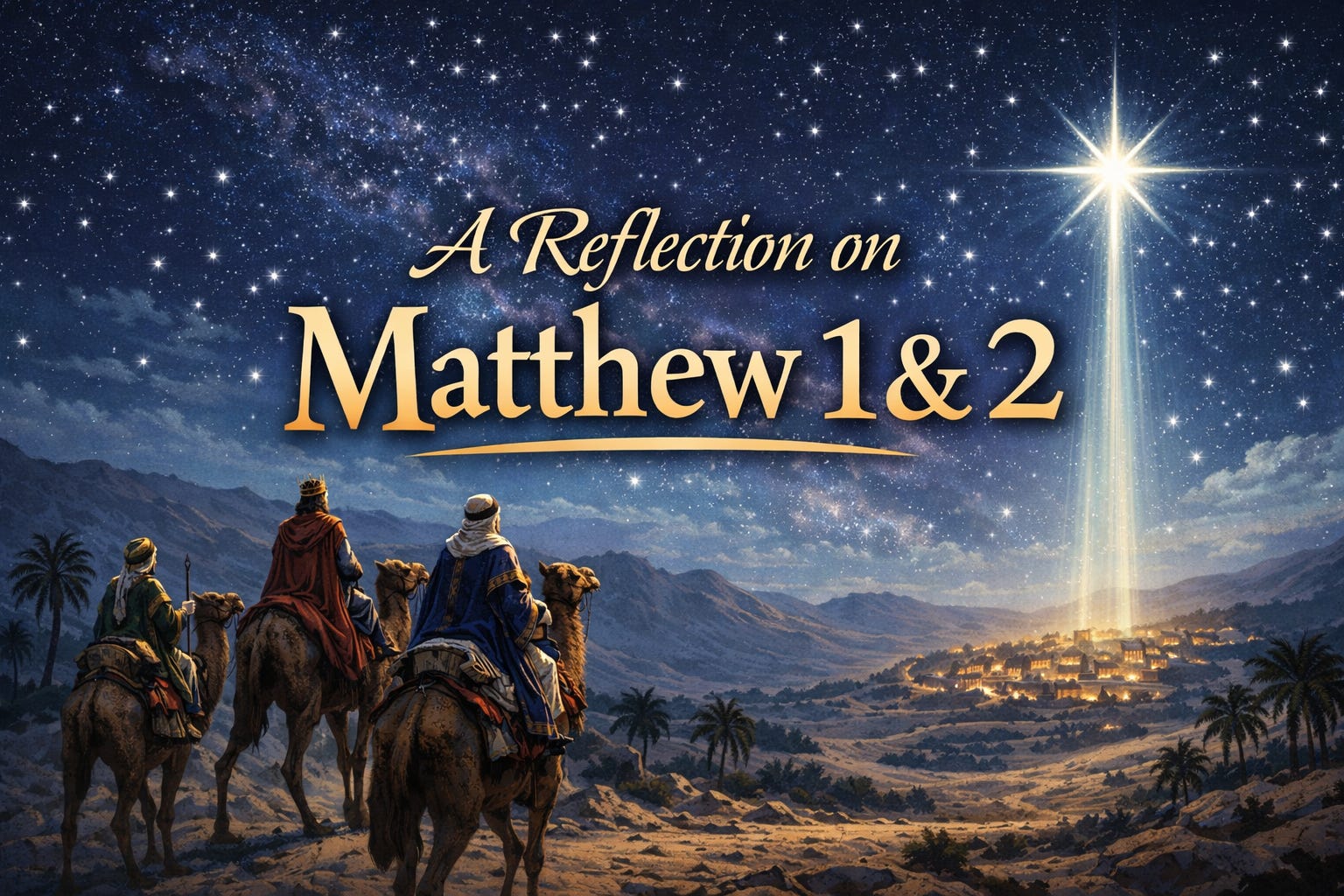
This week, we spent time reading Matthew chapters 1 and 2 in the King James Bible, with a simple but searching goal: to read through the New Testament while asking three guiding questions as we go:
How can we build our faith?
How can we believe God more?
How do we walk away looking more like Jesus?
One thing has become clear to me over the years: the words we read shape what we believe, and what we believe shapes how we live. Matthew doesn’t begin his Gospel with commands or parables, but with history—fulfilled words, obedient responses, and a God who has drawn near.
1. The Genealogy: Faith Rooted in God’s Faithfulness (Matthew 1:1–17)
Matthew opens with a record many people skim past:
“The book of the generation of Jesus Christ, the son of David, the son of Abraham.” (Matthew 1:1, KJV)
But this genealogy quietly builds faith. It reminds us that God works through real people, many of whom failed badly.
Abraham was not always courageous.
Judah committed sexual sin with Tamar.
David sinned grievously with Bathsheba.
Matthew does not soften this. He even records Bathsheba as:
“her that had been the wife of Urias” (Matthew 1:6, KJV)
David’s sin is remembered—but so is God’s promise. The lesson is unmistakable: God’s plan moves forward not because people are perfect, but because God is faithful.
Matthew also highlights the structure of history:
“So all the generations… are fourteen generations… fourteen generations… fourteen generations.” (Matthew 1:17, KJV)
This is not random. Faith grows when we see that history itself is moving according to God’s design.
2. Joseph the Just Man: Faith Expressed Through Obedience (Matthew 1:18–25)
Joseph emerges as a quiet example of righteousness:
“Joseph her husband, being a just man…” (Matthew 1:19, KJV)
When God speaks to him through a dream, Joseph obeys—again and again.
“Then Joseph being raised from sleep did as the angel of the Lord had bidden him.” (Matthew 1:24, KJV)
His obedience is costly and disciplined. He takes Mary as his wife, protects her, and shows self-control:
“And knew her not till she had brought forth her firstborn son.” (Matthew 1:25, KJV)
Faith here is not emotional—it is obedient, restrained, and trusting.
3. Emmanuel: God With Us, Not Far From Us (Matthew 1:22–23)
Matthew pauses to explain prophecy:
“Behold, a virgin shall be with child… and they shall call his name Emmanuel, which being interpreted is, God with us.” (Matthew 1:23, KJV)
Two things stand out.
First, Scripture itself translates the word for us. Explanation is not corruption—it is clarity.
Second, Emmanuel means God with us. God is not distant. He came near—in the flesh.
This truth frames the entire Gospel, ending with Jesus’ words:
“Lo, I am with you alway.” (Matthew 28:20, KJV)
Faith deepens when we realize God is not far off, but present.
4. Prophets Fulfilled: God Keeps His Word
Matthew chapter 1 and 2 repeatedly returns to one theme: fulfilled prophecy.
Bethlehem foretold and fulfilled
Egypt foretold and fulfilled
Weeping foretold and fulfilled
Over and over, God’s earlier words find their exact fulfillment. Faith grows when we see that not a single promise falls to the ground.
5. The Wise Men and Herod: Faith Versus Fear (Matthew 2:1–12)
The wise men follow revelation by faith:
“We have seen his star in the east, and are come to worship him.” (Matthew 2:2, KJV)
They travel far, trust little information, and rejoice when they find Christ:
“They fell down, and worshipped him.” (Matthew 2:11, KJV)
Herod, by contrast, is close, informed, and threatened. The contrast is striking: some Gentiles worship, some of the chosen people resist. This quietly foreshadows much of Jesus’ ministry.
6. Obedient Movement: Faith That Acts (Matthew 2:13–23)
Joseph continues to hear God through dreams—and continues to obey:
“He took the young child and his mother by night, and departed into Egypt.” (Matthew 2:14, KJV)
Travel in that world was dangerous and uncertain. Yet Joseph, Mary, and the wise men all move when God speaks. Faith here walks, flees, returns, and settles—trusting God step by step.
7. Worship as the Right Response
Matthew 1–2 ultimately leads us to one response: worship.
The wise men worship
Joseph obeys
Mary submits
The Scriptures testify
To walk away looking more like Jesus begins here:
“They fell down, and worshipped him.” (Matthew 2:11, KJV)
Key Takeaway
Matthew chapters 1 and 2 show us that God builds faith through His word, keeps His promises exactly as spoken, and calls people to trust and obey Him—even when the path is costly or unclear.
As we read, our beliefs are shaped by God’s words, and those beliefs form lives that increasingly resemble Jesus: humble, obedient, trusting, and worshipful.
If this reflection encouraged you, feel free to subscribe so you don’t miss the next study—or share it with someone who needs a reminder that God keeps His word and walks with His people.