

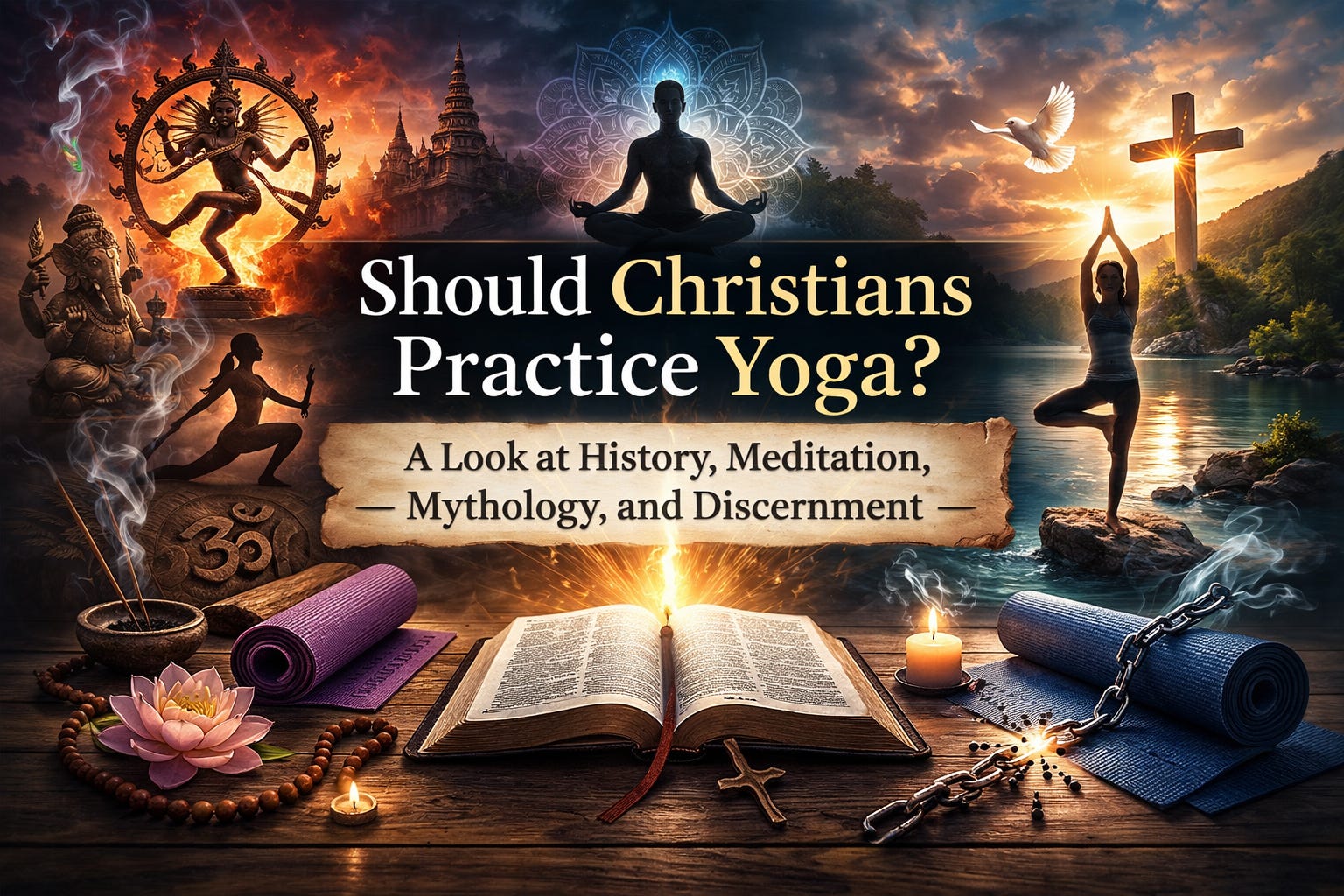
This isn’t a new concern for me. I began researching the history and spiritual roots of yoga many years ago—long before it became as mainstream as it is today. That early research quietly shaped how I viewed the subject. After years of reading and reflection, I eventually shared some of what I had learned, and it generated more conversation than I expected.
Some found the information helpful. Others were unconvinced.
At the time, yoga was already mainstream. Today, it is even more so. Yoga is practiced in churches, schools, gyms, and homes across the world. Most people probably don’t give it a second thought anymore.
But recently the topic came up again. And I believe it’s still worth asking:
What exactly is yoga?
And more importantly:
Can Christians participate in it without concern?
This article isn’t written to shame anyone. It’s written to provide clarity. You can seek the Lord and make your own decision. My goal is simply to help you see what yoga is historically and spiritually so you can make an informed choice.
What Does “Yoga” Actually Mean?
The word yoga comes from the Sanskrit root yuj, meaning “to yoke,” “to join,” or “to unite.” Historically, yoga referred to spiritual disciplines designed to bring a person into union with ultimate reality.
Yoga was not originally a fitness program. It developed inside Hindu philosophical and religious systems.
One of the most influential presentations of yoga appears in Patanjali’s Yoga Sutras, which describe what is often called the “eight limbs” of yoga:
Ethical restraints (yama)
Personal observances (niyama)
Postures (asana)
Breath control (pranayama)
Withdrawal of the senses (pratyahara)
Concentration (dharana)
Meditation (dhyana)
Absorption or spiritual union (samadhi)
Notice something important:
Postures are only one part of a larger spiritual path.
Historically, yoga was not merely stretching. It was a system aimed at spiritual realization and liberation.
Hatha Yoga and the Spiritual Framework
Most of what people practice in the West today falls under what is called Hatha yoga. Classical Hatha texts describe the body as containing subtle energy channels and centers. Practices are intended to purify the body and prepare the practitioner for deeper meditation and spiritual awakening.
Concepts like kundalini, chakras, and energy channels (nadis) are part of this traditional framework.
Modern studios may not emphasize those elements openly. But historically, the postures developed within that spiritual worldview.
Even more interesting, some Hindu advocacy groups have recently pushed back against the idea that yoga is merely “ancient exercise.” They argue that yoga’s Hindu roots are being erased or minimized in Western culture.
If Hindu leaders themselves insist yoga belongs to their religious tradition, that should at least cause us to pause.
Specific Poses With Hindu Mythological Roots
It would not be historically accurate to say that every yoga pose is assigned to a different deity. However, it is accurate to say that some commonly practiced poses and sequences are explicitly connected to Hindu mythology, and many yoga teaching sources openly share those connections.
For example:
Virabhadrasana (Warrior I, II, III) is named after Virabhadra, a warrior figure associated with Shiva.
Natarajasana (Lord of the Dance Pose) refers to Shiva as the cosmic dancer.
Surya Namaskar (Sun Salutation) is one of the most common yoga sequences practiced worldwide, and its name directly connects to Surya, the sun deity.
Vrikshasana (Tree Pose) is frequently taught alongside mythic themes from the Ramayana, including references to Sita and the Ashoka tree in some yoga explanations.
Padmasana (Lotus Pose) is a traditional meditation posture rooted in yogic spiritual practice, often paired with symbolic hand gestures (mudras) used in Hindu meditation traditions.
Utkata Konasana (Goddess Pose) is commonly associated in yoga teaching with goddess symbolism and, in some sources, connected with Kali imagery.
Hanumanasana (Monkey Pose / Splits) is named after Hanuman from the Ramayana.
Ardha Chandrasana (Half Moon Pose) is sometimes explained through mythological stories involving Ganesha and the moon in certain yoga teaching traditions.
These connections do not mean that every modern participant is consciously worshiping a deity. But they do show that yoga postures and sequences emerged inside a religious and mythological system—not inside neutral exercise science.
That historical context should not be overlooked.
Can the Physical Be Separated From the Spiritual?
Many Christians say:
“I’m not doing it spiritually. I’m just stretching.”
That’s understandable.
But here’s the deeper question:
If a practice was historically created as part of a religious path, can it be completely separated from that path simply by changing our intention?
Even when theology is removed, the terminology, structure, and underlying philosophy remain rooted in Hindu spiritual traditions.
Different Christians answer this question differently. But it is a serious issue worth thinking through carefully.
Not All Meditation Is the Same
Another important distinction needs to be made.
When people hear the word meditation, they often assume all meditation is the same. But it is not.
In classical yoga, meditation is aimed at quieting the mind, withdrawing the senses, and ultimately dissolving individual awareness into a higher state of consciousness. The goal is union — absorption — a merging into ultimate reality as defined in Hindu philosophy.
In many modern yoga settings, this may be described in softer language like “clearing your mind,” “emptying your thoughts,” or “becoming one with the universe.”
It is also common to hear the word “namaste” at the end of a class.
The word namaste comes from Sanskrit and is often translated as, “The divine in me bows to the divine in you.” In its traditional context, it reflects the idea that there is a divine essence within each person. That concept aligns with Hindu philosophical ideas about the self (atman) being one with ultimate reality (Brahman).
Many people say “namaste” casually, without thinking about its meaning. But the meaning remains rooted in that worldview.
Christian meditation is very different.
Biblical meditation does not involve emptying the mind. It involves filling the mind — specifically with the Word of God.
Psalm 1:2 (KJV) says:
“But his delight is in the law of the Lord; and in his law doth he meditate day and night.”
Joshua 1:8 (KJV) says:
“This book of the law shall not depart out of thy mouth; but thou shalt meditate therein day and night…”
Christian meditation is not about dissolving into the universe. It is about knowing a personal God. It is about thinking deeply on Scripture, communing with Christ in prayer, and aligning our hearts with His truth.
The Bible never instructs believers to empty their minds, but to renew them (Romans 12:2).
If yoga includes a form of meditation aimed at altering consciousness, emptying the mind, or affirming a view of divinity that differs from Scripture, Christians should at least pause and ask whether that aligns with how the Bible teaches us to seek the Lord.
What About the Benefits?
It is only fair to acknowledge that many studies show yoga can improve flexibility, balance, stress levels, and even certain health markers.
People often feel better after practicing it.
But the question for Christians is not only:
“Does it help physically?”
The question is:
“What is it spiritually?”
Physical benefits do not automatically make something spiritually neutral.
The Question of Syncretism
Scripture repeatedly warns against blending worship practices.
Paul writes in 1 Corinthians 10:21 (KJV):
“Ye cannot drink the cup of the Lord, and the cup of devils: ye cannot be partakers of the Lord’s table, and of the table of devils.”
In 2 Corinthians 6:14 (KJV), we read:
“Be ye not unequally yoked together with unbelievers.”
The word “yoked” is striking in light of yoga’s original meaning — union.
Throughout the Old Testament, Israel often fell not by rejecting God outright, but by mixing their worship with surrounding religious practices.
That blending is called syncretism.
For me, that is where this issue becomes serious.
A Practical Alternative
If someone simply wants:
Strength
Flexibility
Core stability
Controlled breathing
There are alternatives that do not arise from a religious tradition.
Pilates, for example, was developed in the early 20th century as a physical training method. It does not come from a system aimed at spiritual union with a deity.
If the goal is exercise, there are many options.
My Personal Conclusion
I understand that many people won’t be concerned by any of this. And that’s okay. Each person must seek the Lord.
But after studying the history, the structure, the philosophy, and the roots of yoga, I personally would not recommend Christians practice it.
Yoga did not begin as neutral stretching. It developed within Hindu religious traditions aimed at spiritual union. Some of its commonly practiced poses are explicitly named after Hindu mythological figures, and the system as a whole emerged from a worldview that is not Christian.
For me, that is enough to step away.
I would rather pursue exercise that does not carry those roots, and pursue spiritual growth through prayer, Scripture, and fellowship with Christ.
You may reach a different conclusion.
But at the very least, now you can make an informed one.