

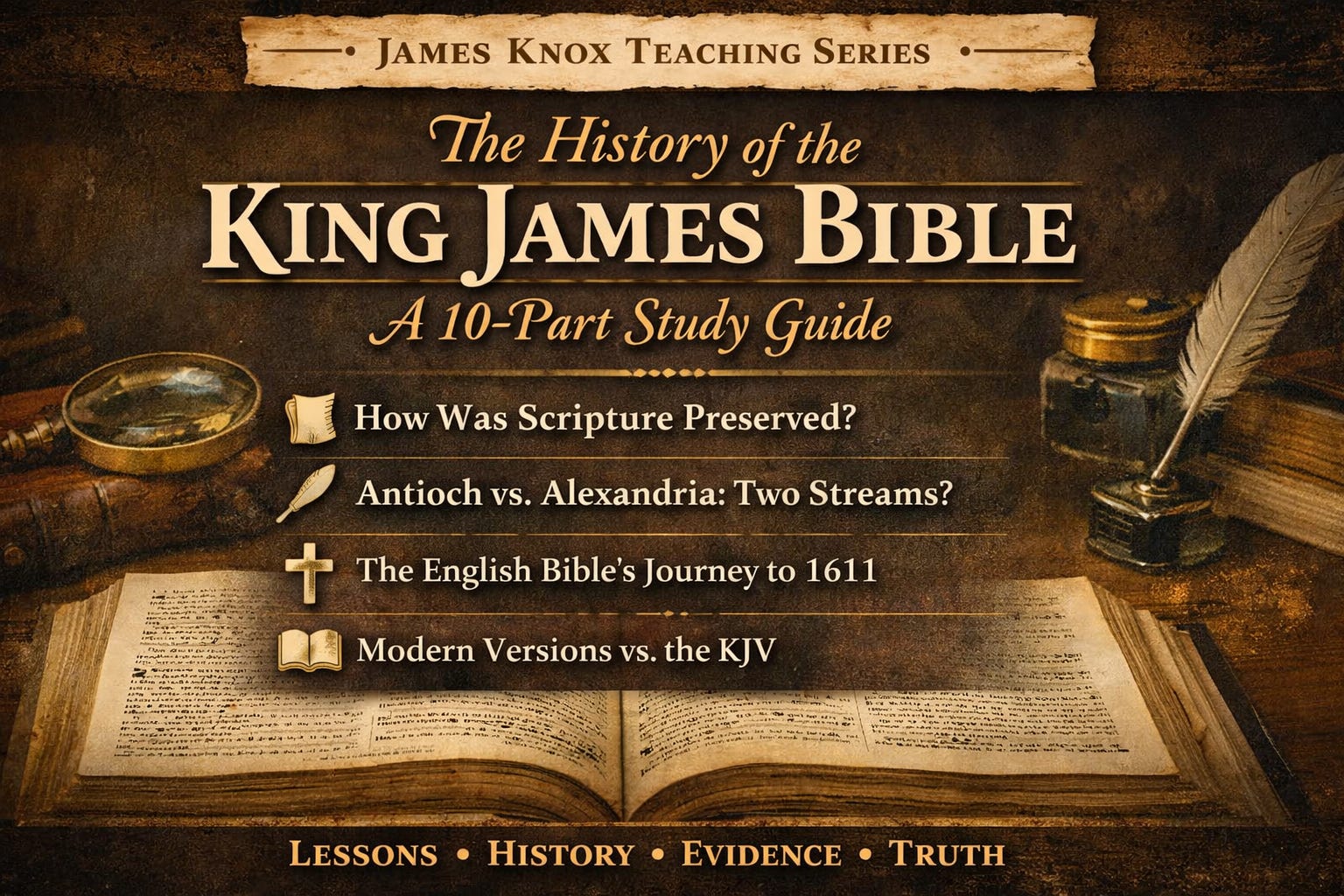
I found James Knox’s 10-part teaching series on the history of the King James Bible so helpful that I wanted to share it here. It’s about 10 hours total, and it covers questions most of us were never taught to think through—like how Scripture was copied, how early the New Testament was known, why different Bible versions exist, and why the KJV became such a stable English Bible for generations.
Since most people don’t have time to watch ten hours of teaching, I’ve written this as a single, readable study guide. If you have time, I do recommend watching the playlist when you can. But if you’re short on time, this post gives you the main ideas—what each part is about, what Pastor Knox is trying to show, and what you should take away from it.
Series Summary
Across these ten lessons, Pastor Knox argues that God’s Word was never meant to depend on access to “the originals,” because even in the Bible’s own story original copies were broken, burned, or lost—and yet God’s words continued. He then builds historical confidence by explaining how carefully Scripture was copied (especially the Old Testament), how early Christian writers quoted New Testament books, and how archaeology supports early and widespread use of Scripture. From there, James explains major shifts in church history—especially when Christianity gained political power—and introduces the idea that different “streams” of text-handling led to different outcomes. Finally, he shows how English Bibles developed step-by-step before 1611, why the KJV translators and process were unusually careful, and why modern versions often differ due to different manuscript choices and 1800s editorial theories—ending with the claim that a faithful translation can still function as a stable final authority for God’s people.
Part 1 — Do We Need the Originals to Trust the Bible?
Summary
James begins with the foundation: the Bible is meant to be a Christian’s final authority, and God never designed faith to depend on documents nobody can access. He points to Bible examples where the first physical copies were destroyed (broken tablets, burned scrolls, sunk scrolls), yet God’s words were still preserved and treated as Scripture. The point of this lesson is to show that “we don’t have the originals” is not a biblical reason to distrust God’s Word.
Quick recap
The Bible must be final authority, or something else replaces it.
The “originals” are not available, and God never required them for faith.
The Bible itself shows originals destroyed, yet God’s words continued.
Conclusion: God preserves His Word for His people to obey.
Part 2 — How Careful Were the Old Testament Scribes?
Summary
In this lesson, Pastor Knox tackles the idea that hand-copying automatically means unreliability. He argues that Old Testament copyists were trained, careful, and reverent toward Scripture. His point is not that scribes were perfect, but that their methods were designed to catch mistakes and protect accuracy.
Quick recap
The scribes treated Scripture as holy, not casual.
Copying was careful, controlled, and accountable.
Knox argues that hand-copying can be extremely reliable when done with strict practices.
Conclusion: the Old Testament text was guarded with serious care.
Part 3 — How Do We Know the New Testament Was Known Early?
Summary
Here James argues that the New Testament wasn’t invented centuries later because early Christian leaders quoted it constantly. Quotations matter because people cannot quote books that do not exist. He references early figures like Polycarp, Ignatius, Irenaeus, and Justin Martyr as witnesses that New Testament books were already used, taught, and treated as Scripture early on.
Quick recap
Early Christians quoted New Testament books heavily.
Quotations are strong evidence of early existence and wide use.
Early church leaders treated the Gospels and apostolic writings as authoritative.
Conclusion: the New Testament was known and used early.
Part 4 — What Does Archaeology Show About Early New Testament Use?
Summary
This lesson adds “real world” support: writing materials, preserved fragments, and why discoveries matter. Pastor Knox describes how early Christians wrote on materials like papyrus and even cheaper surfaces, and how buried history can preserve writings for later discovery. His goal is to show that evidence exists for early spread and early copying of New Testament material.
Quick recap
Writing materials were expensive, so people used what they could.
Archaeology helps show the New Testament existed early and spread widely.
Discoveries support the idea that Scripture survived through real history.
Conclusion: the New Testament was not locked in one place or one century.
Part 5 — “Leaven” Enters: Church Power, Tradition, and Change
Summary
In Part 5, Knox explains a major shift: the church went from persecution to political favor, and he argues this introduced slow corruption—“leaven.” He describes how authority structures, traditions, and philosophical influences grew over time, and why that matters for Bible history. The main idea is that when tradition and centralized power rise, Scripture can be handled less like God’s final word and more like something leaders control.
Quick recap
The early church spread under persecution.
When the church gained power, changes and traditions grew.
Pastor Knox warns that tradition can slowly replace Scripture.
Conclusion: church history affected how Scripture was treated.
Part 6 — Antioch vs. Alexandria: Two Paths of Handling Scripture
Summary
In this lesson, James highlights Antioch and Alexandria and shows how the Bible itself discusses these two locations. He then uses them as a way to explain two different approaches to Christianity and Scripture: one shaped by philosophy and symbolic interpretation, and another shaped by missionary life and receiving God’s words.
Quick recap
Alexandria is presented as philosophy-heavy and allegory-driven.
Antioch is presented as missionary and text-receiving.
Pastor Knox argues these differences shaped later textual traditions.
Conclusion: manuscript history is connected to broader spiritual and cultural movements.
Part 7 — The English Bible Line Before the King James Bible
Summary
Knox walks through the major English Bible steps leading to 1611: Wycliffe, Tyndale, Coverdale, the Geneva Bible, and the Bishops’ Bible. His point is that the KJV wasn’t created in a vacuum. It came at the end of a long refining process where English Scripture was developed, improved, and expanded in reach—especially as printing and access to Greek texts increased.
Quick recap
The KJV came from a long English Bible history, not out of nowhere.
Key names: Wycliffe, Tyndale, Coverdale, Geneva, Bishops’.
Printing and Greek access accelerated Bible spread and refinement.
Conclusion: 1611 was a major milestone in a longer story.
Part 8 — Who Were the KJV Translators and Why Was Their Process Careful?
Summary
This lesson focuses on the translators and the translation method. Pastor Knox argues the translators were highly trained, not amateurs, and that their work was checked through a team-based review process. He emphasizes rules, cross-checking, and careful revision rather than freewheeling rewriting. The aim is to build confidence that the KJV resulted from serious scholarship and serious quality control.
Quick recap
The KJV translators were trained language scholars.
They worked in teams and checked one another.
They followed rules and reviewed across groups.
Conclusion: the process was designed for careful accuracy and stability.
Part 9 — Why Do Modern Versions Differ From the KJV?
Summary
Here Knox explains how manuscript choices drive Bible differences. He discusses major manuscripts often used in modern critical editing and argues that 1800s theories and editorial shifts moved many modern versions away from the “received text” tradition behind the KJV. He uses examples (like Acts 8:37) to show how verses may be removed or placed in footnotes, and why he believes that affects confidence and doctrinal clarity.
Quick recap
Manuscript choices shape the Greek text behind a translation.
1800s discoveries and theories influenced modern critical texts.
Some verses move to footnotes or disappear in modern versions.
Conclusion: differences are not random—they follow different textual priorities.
Part 10 — If We Don’t Have the Originals, Why Can a Translation Still Be Trusted?
Summary
The final lesson ties everything together. James argues that God expects believers to live by His words, so God must have preserved His words in a usable form. He also points out that the Bible uses “translation” positively in several passages, and he defends the KJV’s usefulness, stability, and sometimes greater precision (like singular/plural pronouns). He closes by warning that if Scripture is treated as uncertain, people drift into endless searching for authority rather than living by God’s Word.
Quick recap
The natural man needs the Spirit to understand Scripture truly.
The Bible uses “translation” in a positive way.
A faithful translation can function as real authority for God’s people.
Pastor Knox argues the KJV remains valuable for stability and clarity.
Conclusion: God preserved His Word so His people can trust and obey it.
Final “Quick Recap” of the Entire Series (Parts 1–10)
The Bible does not require access to “the originals” for faith or obedience.
Scripture itself shows originals destroyed, yet God’s words preserved.
Old Testament scribes treated copying as holy work, not casual writing.
Early Christian quotations and witnesses show the New Testament was known early.
Archaeology supports early spread and early use of New Testament text.
Church history includes major shifts as Christianity gained power and tradition grew.
Pastor Knox frames manuscript history through Antioch vs. Alexandria.
The KJV came from a long English Bible line and was produced by careful translators.
Modern versions often differ because they follow different manuscript priorities and editorial theories.
The series ends with the claim that God preserved His words for believers to trust and obey—and that the KJV remains a stable English Bible in that tradition.