

The world always knew me.
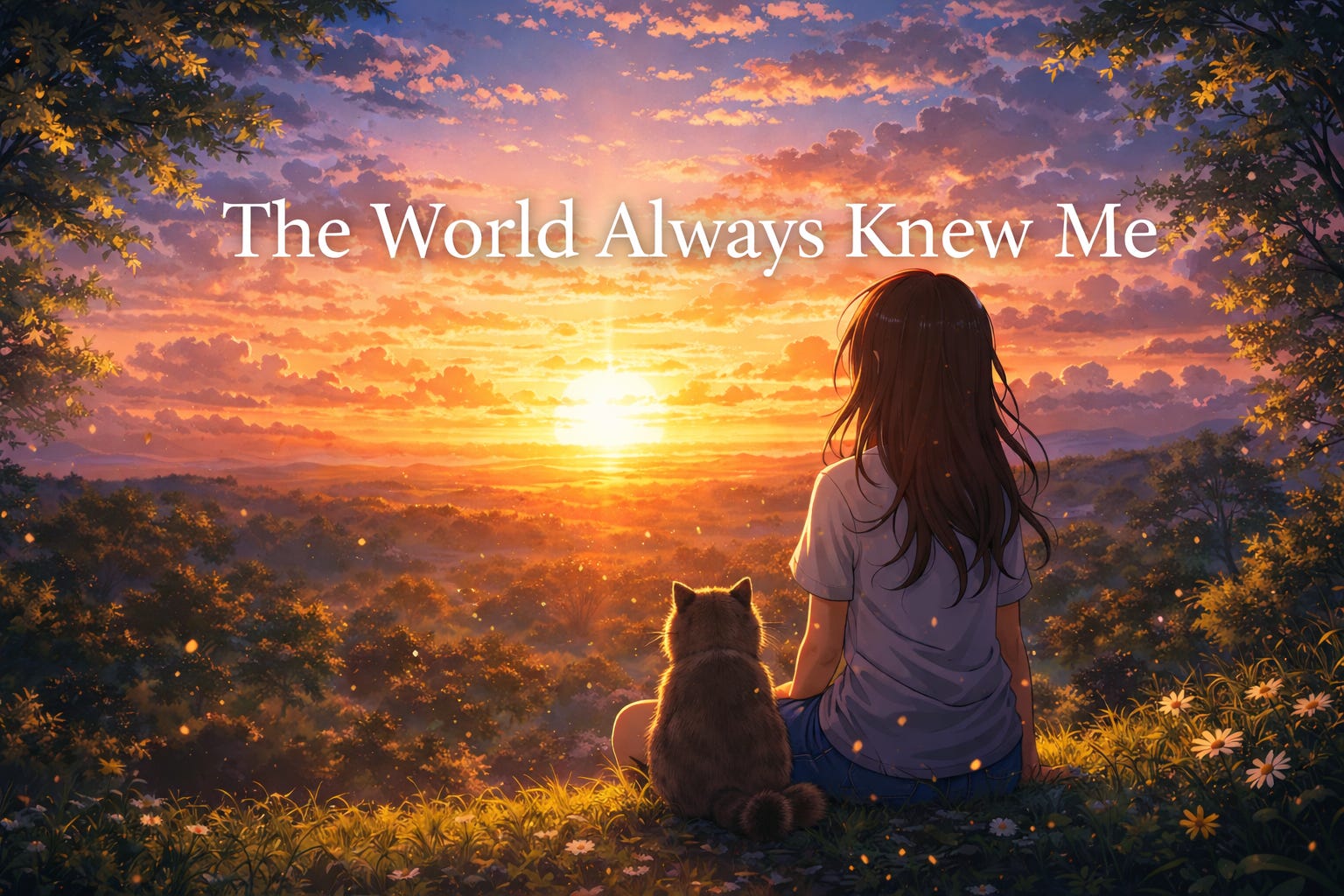
I don’t mean it recognized my face. I mean it felt me coming, the way a room feels a door open before you see who’s there. The ground softened before my feet touched it. Leaves leaned away from the path as if making room. Even the air seemed to slow, like it was waiting to see what kind of day I had decided to bring with me.
I liked to arrive slowly. Rushing never helped. If I moved at the right pace, the world settled into place on its own. Time stretched wide here, generous and forgiving, like an afternoon that had no plans beyond being itself.
The raccoon was already there, sitting beside the path with his tail wrapped neatly around his feet. He always pretended this was coincidence.
“You’re late,” he said.
I smiled. “I’m right on time.”
He tipped his head, considering that, then nodded. “Fair enough.”
We walked together. My boots pressed into the dirt, and the dirt remembered. It always did. I told him what kind of day I wanted—nothing fancy, just gentle—and the world listened the way it always had. The path curved slightly left because I liked that better. A stream appeared where the land dipped, the water catching light in the familiar way that meant I could sit there later if I wanted. The sky softened into that particular shade of blue it used when things were going to be easy.
Everything worked.
That’s why I almost missed it.
A stone slipped from the edge of the stream. I watched it fall, already expecting the splash—but it didn’t splash. It paused in the air, just long enough for my stomach to tighten, then dropped soundlessly into the water.
The ripples came late. They spread too evenly, like they were copying something they’d seen before instead of happening on their own.
I stared.
The raccoon followed my gaze. He squinted at the water, then shrugged. “Gravity’s been distracted lately.”
I laughed, a little too quickly, and nudged the stone back into place with my shoe. “It’s fine.”
And it was. Mostly. The stream kept running. The trees still swayed when the wind passed through them. Birds called from somewhere overhead, their voices layered and familiar. If I didn’t look too closely, nothing seemed out of place.
But I did look.
Later, in the clearing, I tried to set the scene the way I always had. I pictured the market first—the stalls unfolding, the cloth snapping lightly in the breeze, the smell of warm bread rising into the air. For a moment, color bloomed. Bright reds. Sun-washed yellows. The world responded, eager the way it used to be.
Then one stall refused to turn when I placed it—not abruptly, but stubbornly, like it had decided something without telling me. I could feel the hesitation in it, a small resistance that shouldn’t have been there. When I nudged it again, the wood creaked softly, strained, and settled back into the same wrong angle, as if my intention had simply slid off it.
“That’s new,” I said.
The raccoon didn’t joke. He stood and brushed imaginary dust from his paws, slower than usual. “Things change.”
“I don’t want them to,” I said, and pushed harder.
I could feel myself trying—really trying—in that careful, strained way you do when something that once lived in your hands has slipped just out of reach. I was thinking about each movement now, measuring it, second-guessing it. What used to happen without effort suddenly required focus, and even that wasn’t enough.
The harder I pushed, the less the world seemed to notice. Sounds thinned, like someone slowly turning a dial I couldn’t reach. Colors dulled at the edges, then at the center too, until everything looked slightly unfinished. It felt like pressing my palms against a door that used to swing open at a touch and now met me with a firm, unyielding stillness—not angry, not broken, just no longer listening.
That was when I noticed the raccoon felt different.
His voice didn’t bounce the way it used to. His eyes seemed deeper, steadier, like they were holding something in reserve. When I looked away and back again, I couldn’t explain what had changed—only that he no longer felt entirely like the raccoon I’d known.
We kept walking.
The sound came without warning.
A bell rang—sharp and metallic—slicing through the trees where no bell belonged. It echoed too far, too cleanly, and my chest tightened before I could stop it.
“What was that?” I asked.
“Something calling you,” he said.
“I’m not done,” I said quickly.
“I know.”
After that, things stopped behaving properly more often. A woman by the stream repeated the same sentence twice, then went quiet, her mouth still open like she was waiting for something to finish loading. A boy chasing a bird froze mid-step, one foot lifted, his shadow wrong beneath him.
When I turned back to the raccoon, he wasn’t a raccoon anymore.
An old man stood beside me instead, his hair silver, his posture relaxed in a way that felt unafraid. His coat hung heavy on his shoulders, worn soft with use. His eyes were the same.
That’s how I knew.
“You changed,” I said.
He smiled—not apologetically, just kindly. “So did you.”
The ground shuddered beneath us. Somewhere in the distance, a hill folded in on itself like paper. The sky thinned, not darkening exactly, but wearing away, as if someone had rubbed too hard at the blue.
I called out to the others. My voice felt small. No one answered.
The old man stayed.
When the world finally stopped responding altogether, I slumped down hard on the ground. The silence pressed in around me, heavier than noise ever had. It filled my ears until I couldn’t tell where it ended.
Everything was quiet.
“I don’t know how to make it work,” the words came out before I could stop them.
They weren’t what I meant to say, but they were all I had left.
My chest tightened. Tears came fast and uneven, blurring what little remained. I tried to wipe them away, but they kept coming, spilling over and soaking into the ground that no longer remembered me.
The old man sat beside me and drew me into his arms.
He was warm. Solid. His hand rested between my shoulders, steady as breathing. I leaned into him without thinking, my face pressed against the fabric of his coat, and let myself cry until the crying wore itself out.
We stayed like that as the light began to change.
The sky warmed, deepening into gold and soft orange. The sun lowered slowly, touching the edge of a world that no longer quite knew its own shape.
“I was never just one thing,” he said softly. “I was what you needed.”
I listened, feeling the rise and fall of his chest beneath my cheek.
“It doesn’t matter what you make next,” he continued, “or who I become in your next story. I’ll always be here for you—in whatever way you make me.”
The light softened further. The outlines of the world blurred, then faded, like chalk washed away by rain. I couldn’t tell where the ground I knew ended and something else began.
But the warmth stayed.
When I opened my eyes, the sun was still setting—but now it was setting the way suns always had. Quiet. Ordinary. Real. The light didn’t lean toward me anymore. It simply existed.
The old man was gone.
The warmth was not.
A voice reached me from behind, familiar and close.
“Hey,” my mom said. “It’s time to go home.”
I drew in a breath I hadn’t realized I was holding and stood. As I did, I lifted my arm and wiped away the last of the tears from my face.
I turned toward her.
The sun reached me then, warm against my back, and I realized it wasn’t pushing me out of anything. It was lighting the way forward.