

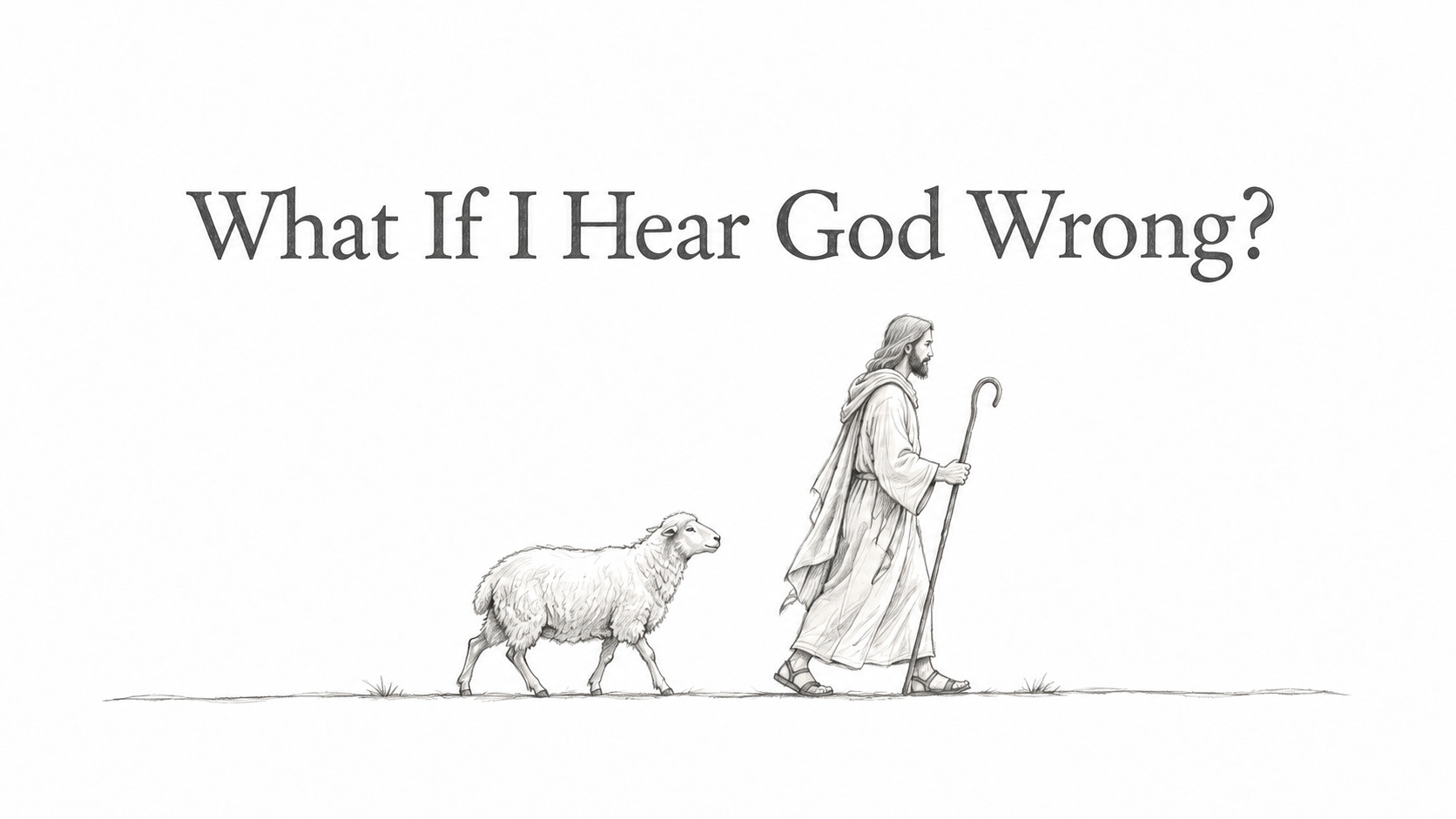
One of the biggest fears people have about hearing God is simple:
What if I get it wrong?
I understand that fear because I have had it too.
Sometimes I have thought the Lord was warning me about something and only recognized it clearly afterward. Other times I have wondered whether what I sensed was really from Him, from my own thoughts, from fear, or from something else.
That can make people want to stop trying altogether.
But I do not think the answer is to become careless, and I do not think the answer is to become afraid.
I think the answer is to learn how to test what we hear.
Hearing God Is a Promise—and Learning Is a Process
Learning to hear Him is both a promise and a process.
Jesus said:
“My sheep hear my voice, and I know them, and they follow me:”
— John 10:27 KJV
But learning to recognize His voice can take time.
There have been moments when I believed the Lord had given me a quiet warning about something and I ignored it because I thought it was probably just me.
Then the thing happened.
Looking back helped me recognize what that warning had felt like.
That does not mean every feeling I have is God.
It means I can learn from both the times I recognized His leading and the times I did not.
If I miss something, I can go back and ask:
What happened?
What did I sense?
Why did I dismiss it?
Was I afraid?
Was I distracted?
Was I assuming something?
Did I state something more strongly than I actually knew it?
That kind of reflection helps us grow.
Start Small Before the Big Decisions
Do not wait until the biggest decision of your life to start learning to hear the Lord.
Imagine never practicing discernment and then suddenly asking:
Should I marry this person?
Should I move across the country?
Should I quit my job?
Should I sell my house?
That creates enormous pressure.
Instead, learn in smaller things.
Ask the Lord who you should encourage.
Ask whether there is someone you should call.
Ask what you should pray about.
Pay attention to what happens.
When the stakes are small, you can learn without feeling like one mistake is going to destroy your life.
Then, when a major decision comes, you have a history of learning, a track record.
And even then, I would slow down.
For something major, do not build your whole decision on one unclear impression.
Go back to Scripture.
Pray.
Ask again.
Seek wise counsel.
Look for confirmation.
Do not be afraid to say:
“I am not sure yet.”
Humility is not unbelief.
Test Everything Against Scripture
This is the strongest guardrail I know.
If something contradicts the written Word of God, I do not need to keep wondering whether it came from Him.
Scripture is the standard.
That is why knowing the Bible matters so much when learning to hear the Lord.
The Bereans give us a helpful example:
“These were more noble than those in Thessalonica, in that they received the word with all readiness of mind, and searched the scriptures daily, whether those things were so.”
— Acts 17:11 KJV
They did not reject everything they heard.
But they also did not accept everything without examination.
They searched the Scriptures.
That is a good model.
Do Not Despise—But Do Test
Paul gives another helpful balance:
“Quench not the Spirit. Despise not prophesyings. Prove all things; hold fast that which is good. Abstain from all appearance of evil.”
— 1 Thessalonians 5:19–22 KJV
I love the balance in that passage.
Paul does not say:
Believe everything.
And he does not say:
Reject everything.
He says not to quench the Spirit or despise prophecy—and then immediately says to prove all things.
That is where I want to live.
Open, but not gullible.
Careful, but not closed.
Willing to listen, but willing to test.
And then hold fast to what is good.
What About “Testing the Spirits”?
I think 1 John 4 is one of the most important passages for anyone learning to hear the Lord.
John writes:
“Beloved, believe not every spirit, but try the spirits whether they are of God: because many false prophets are gone out into the world.”
— 1 John 4:1 KJV
Then John tells us how to test:
“Hereby know ye the Spirit of God: Every spirit that confesseth that Jesus Christ is come in the flesh is of God: And every spirit that confesseth not that Jesus Christ is come in the flesh is not of God...”
— 1 John 4:2–3 KJV
So when I am uncertain about what I am hearing, one of the questions I ask is:
“Did Jesus Christ come in the flesh?”
I do not think that question should be minimized.
John specifically tells believers to try the spirits, and then immediately connects that testing with confessing that Jesus Christ came in the flesh.
That makes this an important biblical safeguard.
If what I am hearing denies Jesus Christ, contradicts who He is, or will not confess that He came in the flesh, I should reject it.
This also fits with the other tests we have already seen.
Does it agree with Scripture?
Does it point toward Jesus?
Does it lead toward the true God or away from Him?
The same principle we saw in Deuteronomy applies here too: supernatural-sounding information is not enough by itself.
The message matters.
The direction matters.
And above all, Jesus matters.
What About the Voice of Accusation?
Another problem is that not every thought that enters our minds is encouraging.
Thoughts can sound like:
You’re not good enough.
God has abandoned you.
You’ll never change.
Nobody wants you.
You’ll never have victory.
God will not provide for you.
Your relationship with Jesus was never real.
Sometimes those thoughts sound very much like our own internal voice.
The important thing is not to assume that every thought deserves to be believed.
Compare it with Scripture.
Does the thought agree with what God has said?
Does it draw you toward Jesus or drive you into hopelessness?
Does it lead toward repentance and restoration, or only accusation and despair?
Knowing Scripture helps us recognize lies.
That is one reason filling our minds with the Word matters so much.
Fear Can Sound Like Guidance
Fear creates another challenge.
Sometimes I may think I am hearing “no” when what I am really experiencing is fear.
Maybe the Lord is leading me into something that requires courage.
Maybe I am uncomfortable.
Maybe I am afraid of what other people will think.
Maybe I am afraid of being wrong.
That is why I do not want fear alone to become my compass.
Sometimes a big decision requires courage, and I do not want fear to cause me to hear a “no” when the Lord may actually be leading me forward.
That is another reason discernment requires time.
Ask again.
Look at Scripture.
Seek counsel.
Pay attention to whether the hesitation is wisdom or fear.
And be willing to wait when you do not know.
What If God Seems Silent?
This may be even harder than hearing something uncertain.
What if you ask and hear nothing?
There may be several possibilities.
Maybe you are distracted.
Maybe you have not yet learned the ways the Lord communicates with you.
Maybe the answer is already clearly given in Scripture.
Maybe you need wise counsel.
Maybe you are expecting one particular form of answer and missing another.
Maybe the Lord is helping you mature.
And sometimes, after praying and seeking Him, you may simply need to make the best decision you know how to make.
Believers have the mind of Christ, and sometimes the Lord may trust a mature believer to move forward with wisdom rather than receive a special answer to every decision.
That idea helped me.
Relationship with God is not meant to turn us into people who cannot choose a restaurant without a revelation.
We grow.
We learn His character.
We learn His Word.
We grow in wisdom.
And if He needs to redirect us, He is able to do that.
Go Back to the Last Thing You Heard
If you feel like the Lord has gone silent after a season when you felt He was speaking clearly, go back and think about the last thing you believed He showed you.
Was there something you were supposed to do?
Was there something you were supposed to address?
Was there something you never followed through on?
I would not automatically assume that silence means disobedience.
But it is a useful question to ask.
Sometimes the next step becomes clearer when we remember the previous one.
Remove the Noise
Sometimes the problem may be much simpler.
We are busy.
Our phones are loud.
Entertainment is constant.
Our minds never stop.
We pray while rushing.
Then we say:
Why can I not hear God?
Sometimes it helps to step away.
Close the door.
Open the Word.
Worship.
Ask questions.
And then stop long enough to listen.
You do not have to become legalistic about distractions.
But if something consistently pulls your attention away from Jesus, it is worth asking whether it needs to be reduced or removed.
And for the things you cannot remove—work, family, responsibilities—take Jesus with you.
Listening to Him is not only something that happens in a quiet room.
Write Things Down
This is one of the most useful habits I developed.
Record what you think you are hearing.
Write down the impression.
Write down the Scripture that came to mind.
Write down the dream.
Write down the question you asked.
Then come back later.
Did it make sense?
Was it confirmed?
Did it contradict Scripture?
Did it produce good fruit?
Did you misunderstand it?
Was your interpretation different from what actually happened?
Writing things down helps because it is easy to forget details, and sometimes we need time to process what we believe the Lord may be showing us.
It gives you something concrete to evaluate.
Memory can change.
A written record helps you learn honestly.
Peace Can Help—but It Is Not the Only Test
I have often looked for peace when making a decision.
That can be helpful.
But peace should not replace Scripture, wisdom, or counsel.
Sometimes fear can make a good decision feel uncomfortable.
Sometimes avoiding something difficult can feel temporarily peaceful simply because we escaped the pressure.
So I want peace to be one part of discernment, not the only part.
The question is not merely:
Do I feel calm?
The larger questions are:
Does it agree with Scripture?
Does it fit the character of Jesus?
Have I prayed?
Have I listened?
Have I sought wisdom?
Is fear controlling me?
Is there confirmation?
Am I willing to be wrong?
If You Get It Wrong, Admit It
This may be one of the healthiest things we can learn.
If you tell someone:
“I think the Lord may be showing me this,”
and it turns out you were wrong, say so.
Do not twist the story afterward.
Do not blame the other person.
Do not invent an explanation just to protect your reputation.
Say:
“I missed that.”
Then learn.
There is freedom in humility.
You do not have to pretend to be infallible.
The Bible is infallible.
You are still learning.
So am I.
Do Not Let Fear Stop You From Listening
The other danger is becoming so afraid of error that we refuse to listen at all.
That was part of my own struggle.
For years, prophecy and hearing God felt dangerous to me because Scripture is complete. I worried that believing God still speaks would somehow compete with the Bible.
But I came to see those as different categories.
Scripture is complete.
Nothing I hear in prayer becomes another Bible verse.
But the God of Scripture is still personal.
So I do not want fear to make me shut Him out.
I want Scripture to make me wiser about how I listen.
A Simple Discernment Process
When you think the Lord may be speaking, slow down.
Ask:
Does this agree with Scripture?
Does it point toward Jesus?
Is this something I know, or something I am merely assuming?
Could fear, desire, or pressure be influencing me?
If this affects another person, can I share it humbly instead of claiming certainty?
If it is a major decision, have I sought wise counsel and confirmation?
Can I write it down and give it time?
Then move forward at the level of confidence you actually have.
Sometimes that may mean acting.
Sometimes that may mean waiting.
Sometimes that may mean saying:
“I do not know yet.”
That is okay.
The goal is not to become someone who never has questions.
The goal is to become someone who knows the Shepherd, knows His Word, and keeps growing in discernment.
You do not need to be gullible.
You do not need to be afraid.
Listen.
Test.
Learn.
Stay humble.
And keep following Jesus.
Next in the series: Practicing Hearing God Safely — how to create an environment where people can practice, receive honest feedback, take small risks, and encourage others without pressure or manipulation.