

One of the most common questions I hear is:
“Why do you use the King James Bible?”
There are many answers to that question. Some are historical. Some are theological. Some are personal.
But sometimes the clearest reasons come from small details—details most readers will never notice unless they slow down and read carefully.
Luke 4:44 is one of those details.
A Small Difference That Isn’t Just “Translation”
In Luke 4:44, English Bibles divide in a meaningful way.
The King James Bible reads:
“And he preached in the synagogues of Galilee.”
(Luke 4:44, KJV)
Many modern versions read instead:
“And he was preaching in the synagogues of Judea.”
This is not merely a wording preference.
It reflects a different underlying Greek text.
And once you notice it, you can’t unsee the effect it has on the passage.
Luke’s Story Is Clearly Set in Galilee
In the surrounding verses, Luke repeatedly tells us where Jesus is:
Jesus returns into Galilee (Luke 4:14)
He teaches in Capernaum, a city of Galilee (Luke 4:31)
He continues preaching in nearby cities (Luke 4:42–43)
Immediately afterward, Luke places Him by the lake of Gennesaret (Luke 5:1)
The lake of Gennesaret is another name for the Sea of Galilee.
Luke never says Jesus leaves Galilee in this section—because, according to the King James reading, He doesn’t.
Why “Judea” Creates a Problem
Judea is not a nearby town.
It is roughly 50–70 miles south of the Sea of Galilee.
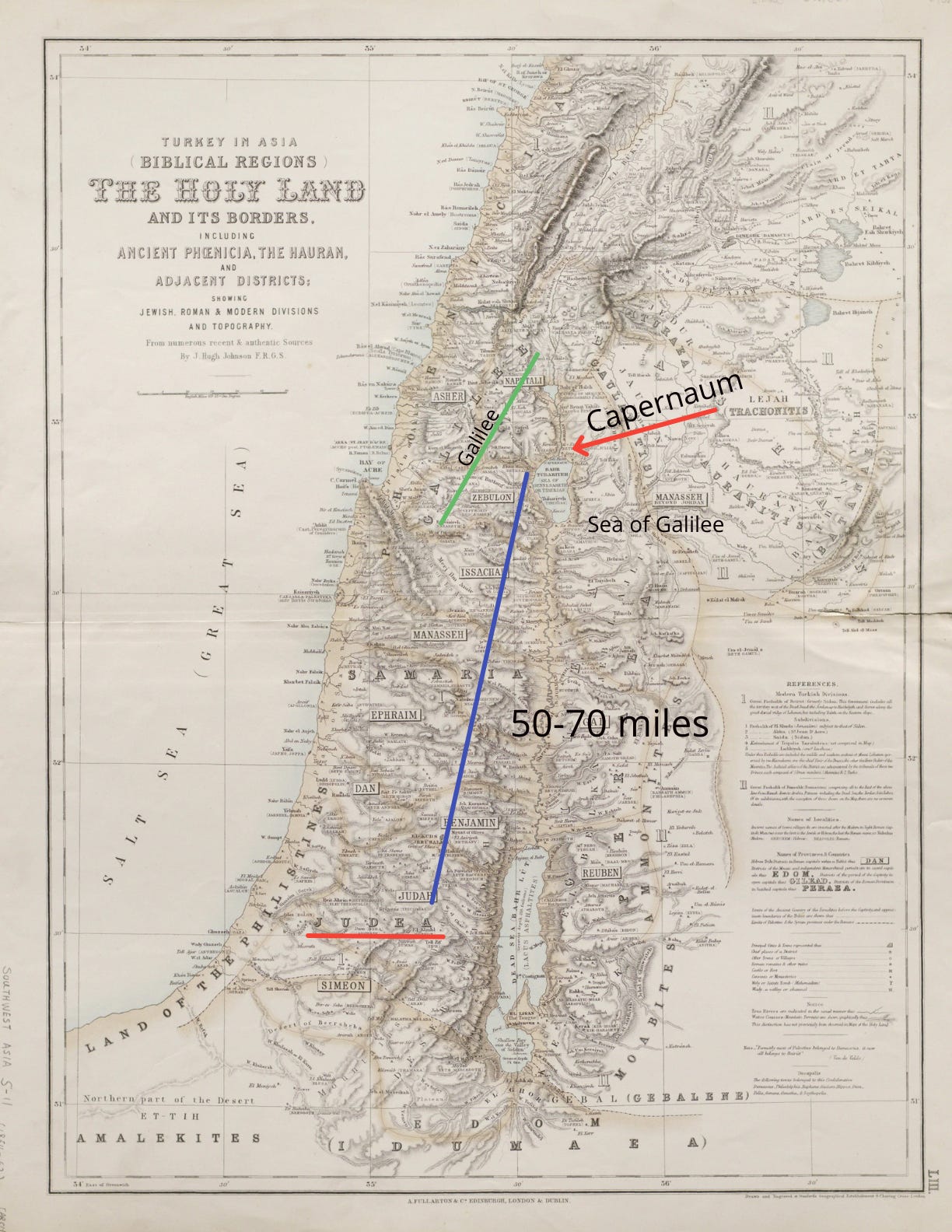

If Luke 4:44 means southern Judea, then Luke’s narrative would require:
a long journey south
no travel notice at all
and then an immediate return to Galilee in the very next verse
That is not how Luke normally writes.
Throughout Luke and Acts, when there is a major geographical move, Luke almost always tells the reader plainly.
Here, he does not.
The King James reading avoids this problem entirely.
Matthew and Mark Quietly Confirm the Galilean Setting
Luke is not alone here.
Both Matthew and Mark summarize this same phase of Jesus’ ministry, and both are explicit:
Matthew 4:23 —
“And Jesus went about all Galilee, teaching in their synagogues…”
Mark 1:39 —
“And he preached in their synagogues throughout all Galilee, and cast out devils.”
So when the King James Bible reads “Galilee” in Luke 4:44, all three Synoptic Gospels agree.
When modern versions read “Judea,” Luke suddenly becomes the exception—right in the middle of an otherwise unified picture.
“The King James reading explains the passage naturally.
The alternative requires explanation.”
“But Matthew Mentions Judea—Doesn’t That Matter?”
Yes, it does—but not in the way some assume.
Just a few verses later, Matthew says this:
“There followed him great multitudes… from Galilee, and from Decapolis, and from Jerusalem, and from Judea, and from beyond Jordan.”
(Matthew 4:25)
Notice what Matthew is describing.
He is not saying Jesus was ministering in all those places.
He is saying people came from those places to hear Him.
That distinction matters.
Judean crowds traveling north to Galilee makes perfect sense.
Jesus quietly bouncing from Galilee → Judea → Galilee without explanation does not.
Matthew’s mention of Judea actually fits the KJV reading of Luke 4:44 very well.
Luke Was Careful—and the KJV Preserves That Care
Luke consistently distinguishes between:
Galilee
Judea
Jerusalem
He does this throughout his Gospel and again in Acts. He names places carefully and marks journeys clearly.
When Luke 4:44 is read as Galilee, the passage flows smoothly:
Galilean ministry
Galilean synagogues
Galilean lake
Nothing breaks. Nothing needs redefining. Nothing needs a footnote to explain why Jesus is suddenly somewhere else.
Why This Matters (Even If You’re Not a Scholar)
This isn’t about winning arguments or scoring points against modern translations.
It’s about a simple question:
Do I want a Bible that reads clearly and consistently on its own—
or one that regularly needs to be explained away?
Luke 4:44 is a small verse, but it illustrates a larger pattern.
Again and again, the King James Bible preserves readings that:
respect the author’s style
honor geographical reality
align naturally with parallel Scripture
and allow the text to speak for itself
Belief and the Scripture
I’m not asking anyone to change Bibles overnight. Although, I do think it’s a good idea.
I am encouraging readers to slow down, read carefully, and notice what happens when Scripture is allowed to interpret itself.
Sometimes, the more closely we look, the clearer the ancient paths become.
Footnotes
Luke consistently marks major travel elsewhere (e.g., Luke 2:4; 17:11; 19:28; Acts 11:2).
Luke regularly distinguishes Galilee, Judea, and Jerusalem as separate regions (Luke 3:1; 5:17; Acts 10:37).
Matthew 4:23 and Mark 1:39 are parallel summary statements describing the same phase of ministry as Luke 4:44.
Matthew 4:25 describes the origin of crowds, not Jesus’ location.
Luke 5:1 anchors the narrative geographically at the Sea of Galilee immediately after Luke 4:44.