

A simple question about a serious change
Would you be comfortable with your Bible changing from God saying “I am Alpha and Omega” to “I have become, I, the Alpha and the Omega”?
That question is why I am writing this article.
In the King James Bible, Revelation 21:6 reads:
“And he said unto me, It is done. I am Alpha and Omega, the beginning and the end. I will give unto him that is athirst of the fountain of the water of life freely.”
— Revelation 21:6, KJV
But the University of Münster announced a different reading in a new scholarly Greek edition of Revelation:
“I have become, I, the Alpha and the Omega”.
The announcement called this a “theological difference in meaning.” In plain language, that means a difference in what the passage says about God.
I have often heard that differences among biblical manuscripts do not affect doctrine. Yet here was the university whose research institute helps lead the reconstruction of the Greek New Testament describing a change in theological terms.
And this is no longer just an announcement. I have seen the new reading in my own copy of UBS 6, a Greek New Testament used by translators and students.
The critical Greek text is still being revised. Revelation 21:6 is a concrete example.
I believe God has preserved His Word, and I believe we have that preserved Word in the King James Bible. I want to show you what changed, why it matters, and why it strengthens my conviction to stay with the KJV.
See the evidence
What changed
On August 7, 2024, the University of Münster published an English announcement about new volumes of the Editio Critica Maior, usually shortened to ECM. This is a detailed edition of the Greek New Testament based on comparisons of surviving manuscripts, or handwritten copies.
The announcement identifies Revelation 21:6 as its most significant change from the previously published text. It explains the theological distinction as God always being the first and last versus becoming the first and last. It says the editors preferred the new reading because of their assessment of the manuscript evidence and how the other reading arose.
Read the original University of Münster announcement.

Why Münster’s work can reach your English Bible
The University of Münster in Germany is home to the Institute for New Testament Textual Research, or INTF. Its researchers study the manuscript evidence and work to reconstruct the initial Greek text of the New Testament.
A text assembled by evaluating different manuscript readings is called a critical text. The word “critical” refers to that process of evaluation.
Münster’s institute helps produce the editions that scholars and translators use. The Revelation project also involved researchers at the Protestant University Wuppertal. This is a shared scholarly effort with a direct connection to Bible translation.
Here is how that connection works:
Researchers compare manuscripts. They examine places where the handwritten copies differ.
Editors choose the Greek wording. The ECM publishes the text they judge best supported.
Working Greek editions adopt the changes. These include the United Bible Societies’ Greek New Testament and the Nestle-Aland edition.
Translators consult those editions. Their decisions can carry the changes into new or revised English Bibles.
Read about the INTF and its work.
You do not need to remember every abbreviation. The important point is that this research helps shape the Greek text from which English translations are made.
The change has already reached UBS 6
The sixth edition of the United Bible Societies’ Greek New Testament is called UBS 6. The German Bible Society confirms that it adopted all the ECM textual changes in Mark, Acts, and Revelation.
My photograph shows these words in Revelation 21:6:
γέγονα ἐγώ
These are the words behind Münster’s rendering “I have become, I.”
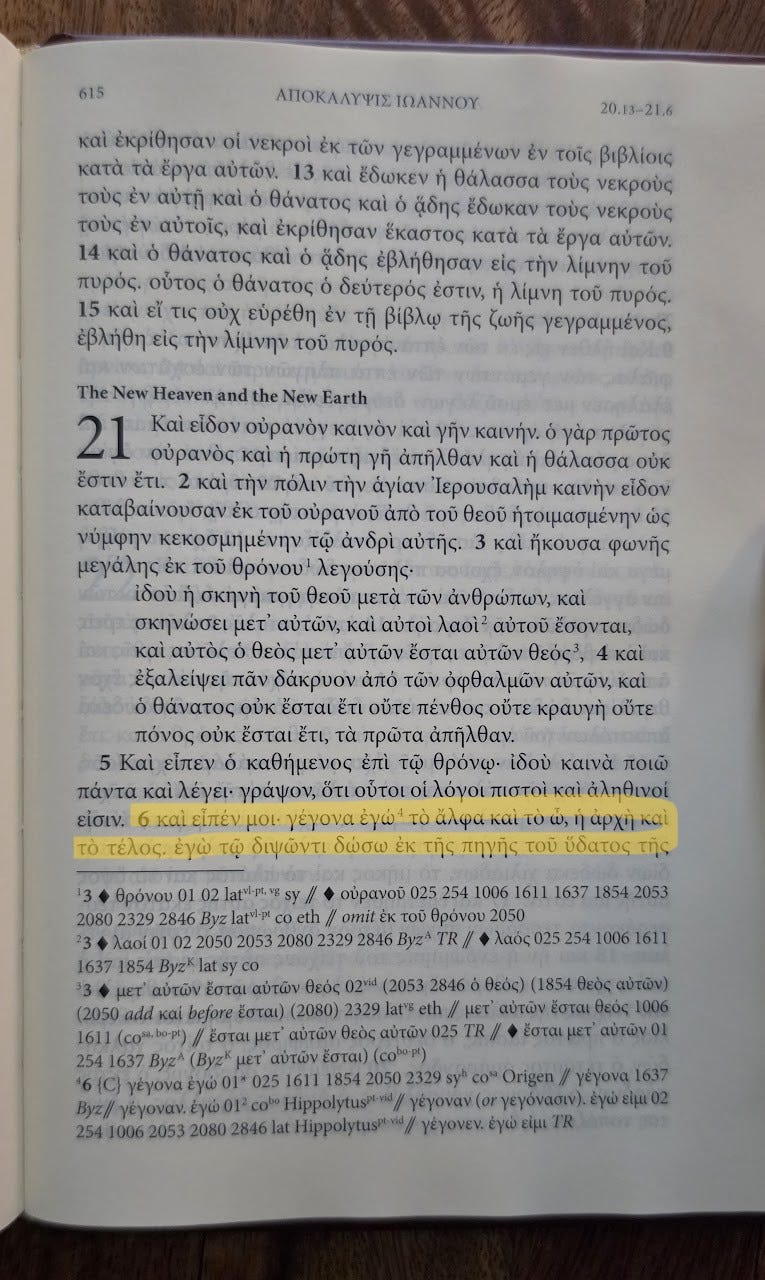
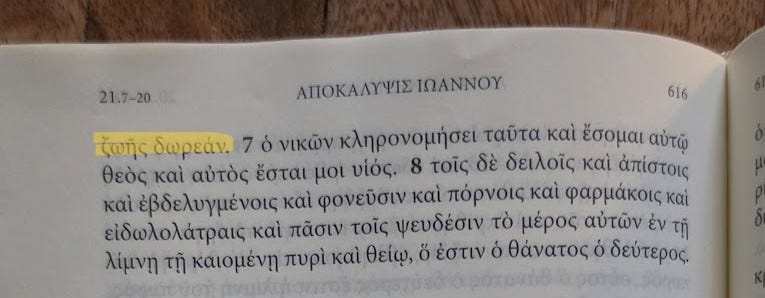
The change is also included in the published plans for NA 29, the 29th Nestle-Aland edition. Hendrickson’s description says UBS 6 shares its Greek text with NA 29. The German Bible Society’s NA 29 listing advertises all ECM textual changes and specifically names Acts, Mark, and Revelation. That includes the Revelation 21:6 change.
Münster’s announcement also said:
“This change will have an impact on all new translations.”
That is the university’s prediction. Translation committees still decide whether to adopt the reading and how to translate it; the announcement does not establish that every English Bible will change in the same way or at the same time.
But translators using these newer editions for an English translation or revision will encounter this changed Greek wording. The source text has already changed. That is why Christians should pay attention before a change appears in the Bible they read each day.
Why the wording matters
Revelation 21:6 is a declaration by God, the one seated on the throne. The question is what He declares about Himself.
Alpha and Omega are the first and last letters of the Greek alphabet. In this verse, the title stands alongside “the beginning and the end.”
Being Alpha and Omega and becoming Alpha and Omega are not the same statement. The KJV declares who God is. Münster’s rendering raises a question about becoming what He already is.
Read the related passages together.
Revelation 1:8
“I am Alpha and Omega, the beginning and the ending”
In the current ESV, Alpha and Omega remains, but “the beginning and the ending” is omitted.
Revelation 1:11
“I am Alpha and Omega, the first and the last”
In the current ESV, this entire declaration is omitted.
Revelation 1:17–18
“I am the first and the last: I am he that liveth, and was dead”
In the current ESV, the connection between the first and last and the one who died remains.
Revelation 21:6
“It is done. I am Alpha and Omega, the beginning and the end.”
In the current ESV, the familiar wording remains. It has not been replaced by Münster’s new rendering.
Revelation 22:13
“I am Alpha and Omega, the beginning and the end, the first and the last.”
In the current ESV, all three titles remain, in a different order.
Compare these passages on the ESV publisher’s website.
The chapter 1 omissions predate the new Revelation 21:6 decision. They show why my concern extends beyond one verse. Words connecting these titles are already missing from critical-text translations.
A person reading only a critical text translation may never realize these statements are missing from their translation and appear in the KJV. That reader still sees some important testimony to these titles, but does not see all the same repeated connections.
The German Bible Society advertises almost 100 textual changes in ECM Revelation compared with NA 28. These are not all omissions or equally significant. But the revision clearly reaches beyond Revelation 21:6.
How can God become what He already is?
Even in the ESV, Revelation 1:8 identifies God as Alpha and Omega.
If God is already Alpha and Omega, how can He later become Alpha and Omega?
If the title has the same meaning in both passages, and “become” means acquiring an identity He previously lacked, those claims are inconsistent. God cannot first acquire an identity that has always been His.
Someone might explain the new reading as God bringing His purposes to completion rather than acquiring a new identity. But that explanation needs support from the words and context. It should not simply be assumed, especially given Münster’s own explanation of the difference.
In the KJV, the connection reads naturally. God is Alpha and Omega in chapter 1 and declares that same identity in chapter 21. The KJV gives a consistent testimony without introducing this question about becoming.
Read Revelation 1, Revelation 21, and Revelation 22 in the KJV.
What readers may not see in a footnote
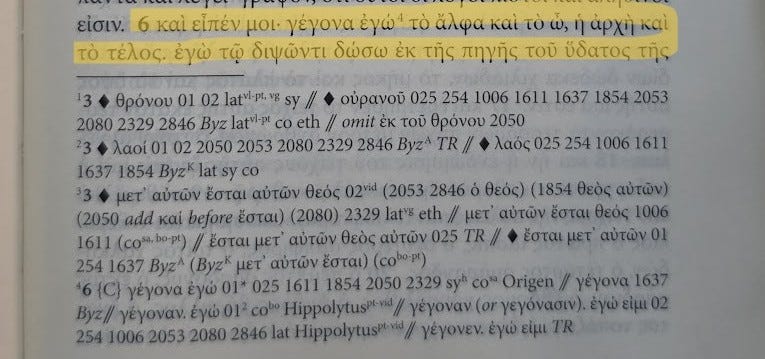
Most Christians will never examine the Greek text behind their English Bible. But this photograph from my UBS 6 shows the decision being made before an English translation reaches the reader.
The editors list several possible readings in the footnote. The reading behind the KJV’s “It is done. I am” is marked TR, meaning Textus Receptus. The new reading appears above it in the main text.
The familiar wording is still recorded, but it is not the wording this edition chooses for the verse. That choice matters because translators using UBS 6 will encounter the new reading as they prepare English translations.
What about the assurance that doctrine does not change?
There is an important distinction here:
A doctrine can remain supported elsewhere in Scripture.
A particular verse can still change in meaning.
For example, Got Questions argues that manuscript differences do not put any major biblical doctrine in doubt. That is different from saying no passage changes in theological meaning.

Someone could accept a change in this verse while arguing that God’s eternal nature remains clearly taught elsewhere. But that still leaves my concern unanswered: What has happened to the testimony of this verse?
Finding the doctrine somewhere else does not make the wording here unimportant. We read and preach individual passages. Their meaning matters.
My question for anyone defending the new reading is simple: Does it change what Revelation 21:6 teaches about God? If Münster’s explanation overstates the difference, what is the better explanation, and what evidence supports it?
A changing text raises a question about preservation
When I first began studying these issues, I spoke with ministers, theologians, and scholars. I was disappointed when some described the biblical text as unfinished and told me we probably would not have a finished text in our lifetime.
Revelation 21:6 is a concrete example of what I mean by an unfinished critical text. A reading printed in earlier editions has been replaced in a newer one. Its wording remains open to revision.
I am basing my life, my faith, and my hope of eternal life on what God has said about Jesus Christ. The words matter to me.
Jesus said:
“Heaven and earth shall pass away, but my words shall not pass away.”
— Matthew 24:35, KJV
That promise is central to why I believe preservation matters. I do not believe God gave His words only for His people to lose them. I do not believe His people had to wait for nineteenth-century manuscript discoveries or modern editorial work to recover His preserved Word.
My confidence does not depend on treating Sinaiticus or Vaticanus as the place where God’s Word had to be recovered after being lost. I believe His words remained available to His people, and I believe we have His preserved Word in the King James Bible.
That is why pastors should address preservation alongside inspiration. If a church’s doctrinal statement says Scripture is without error in the original writings, what does that mean for the Bible its members can read today?
Can your pastor point you to a finished Bible—a settled text containing all the words God intended us to have?
By “finished,” I mean its words are settled, and scholars are not trying to reconstruct the original or initial text.
If the answer is that the text is still being reconstructed, ask:
What assurance do we have that other important passages will not change in future editions?
How should Christians respond when a revision changes the meaning of a passage?
Where can we read the words our church believes God has preserved?
These are questions for ordinary believers, because this is the Bible we read, teach our children, and build our lives upon.
Why I invite you to consider the KJV
This example does not settle every question about Bible history. But it shows that the critical text remains open to changes that can affect how a passage is understood.
The KJV’s wording in Revelation 21:6 is not waiting for the next ECM decision. It declares, “It is done. I am Alpha and Omega, the beginning and the end.” That agrees naturally with God’s declaration in chapter 1.
I believe the King James Bible is God’s preserved Word. Its settled wording gives me confidence as I read and study. By that, I mean the received wording I read is not being revised to follow each new critical edition—not that the KJV has no history of printing corrections and editorial differences.
If you have never seriously considered using the KJV, I invite you to begin with the passages in this article. Read them in context. Compare the wording. Follow the source links and look at the photograph of UBS 6.
You do not have to know Greek to recognize that “I am” and “I have become” raise different questions. You can ask what changed, why it changed, and whether you are comfortable building your study on a text that remains open to this kind of revision.
For me, this is another reason to stay with the King James Bible. I believe God has preserved His Word, and I want to read, trust, and live by it.
Would you be comfortable with your Bible’s reading of Revelation 21:6 changing from “I am Alpha and Omega” to God saying, “I have become, I, the Alpha and the Omega”? Why or why not?