

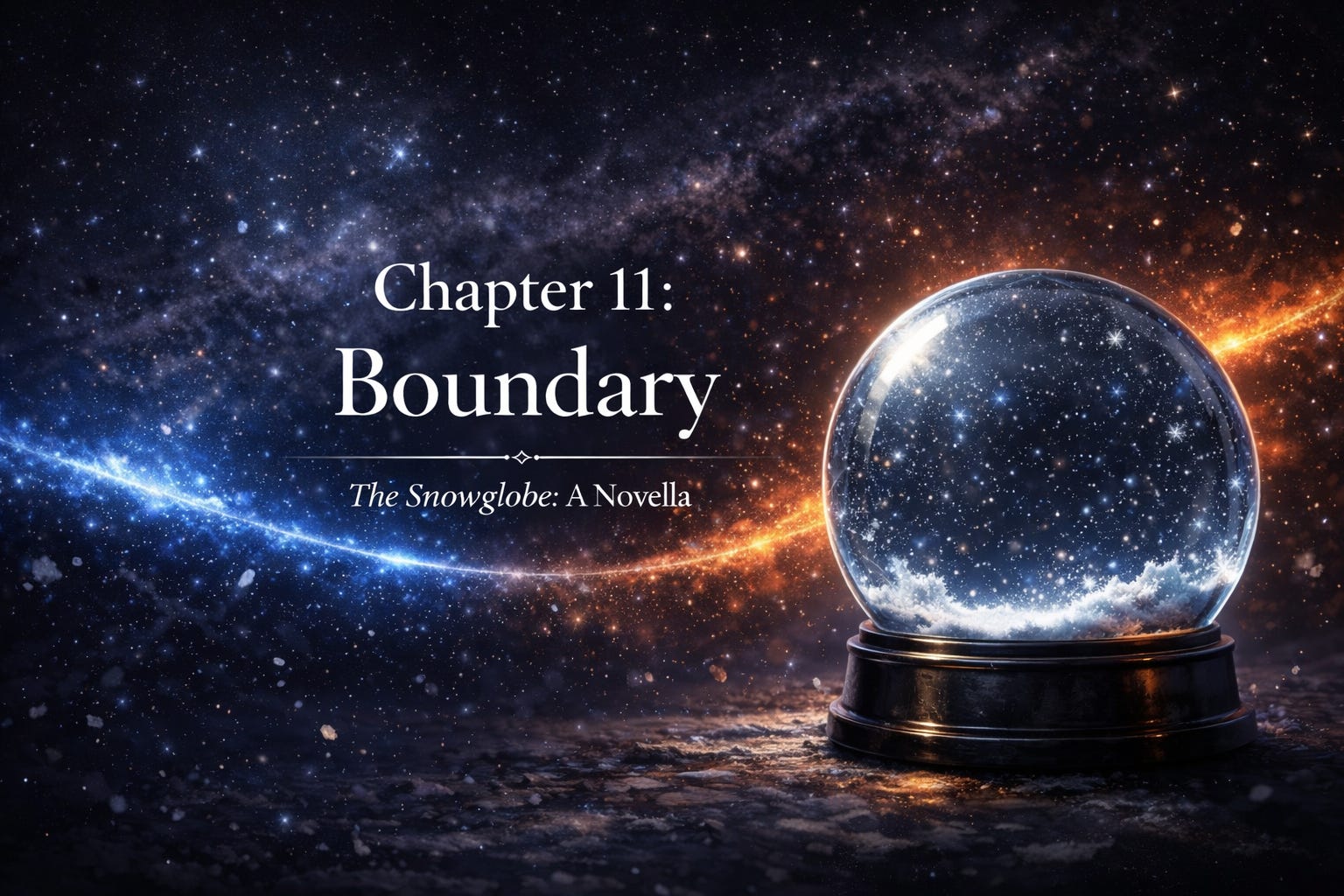
At 300,000 feet, the dome was everything.
It filled the viewport completely. Edge to edge, top to bottom, there was nothing else to see. No Earth below—he’d climbed too high, the angle too steep. No darkness of space—there was no space, just this vast crystalline ceiling that stretched in every direction.
Just the dome.
The craftsmanship was overwhelming. Mercer’s pilot mind tried to process the scale and failed. The vast forms he’d seen earlier weren’t just massive—they were architectural. Patterns within patterns, spiraling down into complexity that suggested infinite depth. They were beautiful in the way that only something made could be beautiful—not accidental, not random, but consciously crafted by a hand he couldn’t comprehend, down to details his eyes couldn’t quite resolve.
Between these forms, the crystalline surface caught and refracted light in ways that revealed its true nature. It was strong—impossibly, undeniably strong. The kind of strength that didn’t bend or yield, that held against forces that would shatter anything human hands had ever built. It was strong like molten glass made solid, reflective and luminous, catching his lights and throwing them back at him in patterns that seemed almost alive. The surface moved with a presence that suggested intention itself—not mechanical, but alive with purpose.
The structure had depth—layers visible within layers, each one slightly different in texture and opacity, each one contributing to a whole that was fundamentally unbreakable. And embedded throughout, set deep within this crystalline architecture, were the lights.
The stars.
They weren’t distant suns. They were fixtures. Luminous points set into or attached to the dome’s surface, each one positioned with deliberate precision. Some clustered in familiar patterns—constellations he’d known since childhood, now revealed as intentional arrangements rather than random scatter. Others spread in formations that suggested purpose beyond human understanding, meaning written in light across the dome’s surface. All of it spoke of something that had been made. Designed. Intended. Sheweth his handywork.
This was the ceiling of the world, and it had been made by hands that understood strength in ways human engineering never could.
The altimeter read 305,000 feet. Fifty-seven miles up.
Mercer could see where he was going to hit. His trajectory would take him to a section between two major forms—a relatively clear expanse of crystalline surface perhaps a mile across. The surface there showed those patterns he’d noticed earlier, more clearly now. They might have been inscriptions. They might have been structural reinforcement. They might have been something else entirely.
He was going to find out.
The fuel gauge read 10%.
The temperature gauge showed -138°F.
The radiation monitor maintained its steady beeping—that familiar rhythm that had been his companion for the last hundred thousand feet. Almost comforting now, in its consistency.
The throttle was at maximum. The engines hummed with the strain of pushing against thinning atmosphere and depleting fuel. His acceleration was decreasing—he could feel it in the way the altimeter’s climb had slowed slightly. Not much. But enough to notice.
310,000 feet.
The dome’s surface showed more detail now. He could see seams where the crystalline grew together seamlessly, like veins of light running through a single unified whole. Each seam was itself perfect—not joined but grown, as though the entire structure was one continuous creation rather than parts fitted together. And it was impossibly strong, built to hold back something vast.
How much force did this thing withstand? How much pressure from the atmosphere below, pushing up against it? How much weight from... what? What was above the dome, if anything?
Questions he’d never get answered. Questions nobody in the Directorate would ever acknowledge as valid.
315,000 feet.
The fuel gauge read 8%.
Mercer’s breathing was steady. His heartbeat was elevated but controlled. His hands on the controls showed no tremor. Years of training, years of flying, had prepared him for high-stress situations.
Though probably not for this specific situation.
The absurdity of it struck him—the dark humor that had sustained him through this entire climb. He was about to crash a rocket into the ceiling of the world, and somewhere far below, people were probably watching their screens, trusting the Directorate’s explanations, never imagining that the sky had a surface.
320,000 feet.
The altimeter’s number triggered a memory.
“Tell me about the Karman Line,” Mercer had said.
Sarah had pulled up a diagram. “It’s the official boundary between Earth’s atmosphere and outer space. Defined at 100 kilometers—about 62 miles, or 328,000 feet.”
“Why there specifically?”
“It’s named after Dr. Werner Karman. He calculated that at that altitude, the atmosphere becomes too thin to support aeronautic flight. The air density is so low that an aircraft would have to travel faster than orbital velocity to generate enough lift. So that’s where we define space as beginning.”
Mercer had studied the diagram. “So it’s a mathematical calculation based on atmospheric density and flight dynamics.”
“Exactly. It’s physics.”
“Or,” Mercer had said slowly, “it’s the altitude where they hit something and had to come up with an explanation.”
Sarah had gone very still.
“Think about it,” Mercer continued. “They send up rockets, balloons, whatever. They reach about 62 miles. And then... nothing goes higher. So they need a reason. They need to explain why that’s the boundary.”
“So they define it as the edge of space.”
“They define it as the altitude where space ‘begins’ because that’s as high as anything can go. Not because of some calculation about lift and orbital velocity. Because there’s a physical barrier there.”
Sarah had stared at the diagram. “The Karman Line isn’t a calculation. It’s an observation they had to explain away.”
“They defined the edge of space at exactly the altitude where the dome is.”
“Because that’s as high as anything can go.”
Mercer had nodded. “When I reach the Karman Line, Sarah... I’m going to hit it.”
She’d looked at him for a long moment. “That’s what you’re counting on.”
“That’s what I’m counting on.”
322,000 feet.
The fuel gauge read 6%.
The dome filled everything. Mercer could see individual textures now—the way light moved across the crystalline surface, the subtle variations in opacity, the precise geometry of those patterns that might have been inscriptions. The embedded lights blazed with steady brilliance, unwavering, eternal.
This was what held the sky in place. This was what contained the world. This was the boundary that generations had been taught didn’t exist.
325,000 feet.
Fuel at 5%.
The engines were struggling now. He could hear it in their pitch, feel it in the decreasing acceleration. The rocket was giving everything it had, burning the last of its fuel to push him those final few thousand feet.
It would be enough. The math was clear. His velocity would carry him to the Karman Line even if the engines cut out completely.
He was going to make it.
327,000 feet.
Fuel at 4%.
The radiation monitor beeped its steady rhythm. The temperature gauge read -142°F. The gravity sensor still showed 99.7% of surface gravity—impossible, according to their models, but there it was.
Everything they’d taught was wrong. Everything they’d claimed was a lie. And the proof was right in front of him, filling his viewport, close enough to touch.
Close enough to hit.
328,000 feet.
The Karman Line.
The official boundary between Earth’s atmosphere and outer space.
The altitude where Dr. Werner Karman had calculated that aeronautic flight became impossible.
The altitude where the dome was.
Fuel at 3%.
Mercer could see exactly where he was going to hit. A section of crystalline surface between two support structures, marked with those geometric patterns, embedded with star-lights that blazed like beacons. The surface was perhaps a hundred yards away now. Maybe less.
His velocity was still carrying him forward. The engines were barely firing—fuel nearly exhausted—but momentum was enough.
The geometry of creation stretched above him. The architecture of the world’s ceiling. The proof that everything was contained, bounded, designed.
Made.
His heartbeat was loud in his ears. His breathing steady. The radiation monitor’s beeping had become almost musical—a metronome marking the final seconds.
The altimeter read 328,500 feet.
Fifty yards to impact. Maybe less.
The dome’s surface showed every detail now. The crystalline layers. The embedded lights. The patterns that might have been writing in a language he didn’t know. The seams where sections joined. The way light refracted through depths he couldn’t measure.
It was beautiful.
Twenty yards.
Mercer’s hands were steady on the controls. There was nothing left to do. No adjustments to make. No course corrections. Just the final approach, the inevitable conclusion, the moment of truth.
Ten yards.
He could see his reflection in the crystalline surface. The rocket. Himself in the cockpit. A tiny speck approaching the ceiling of the world.
Five yards.
The fuel gauge read 2%. The engines sputtered. The radiation monitor beeped. The temperature gauge showed -145°F.
The altimeter read 328,800 feet.
The dome filled the viewport, filled the world, filled everything.
Captain James Mercer, decorated pilot, truth-seeker, madman, opened his eyes wide.
And touched the face of God.
The Snowglobe
This is a work of fiction. Names, characters, places, and incidents are either products of the author’s imagination or are used fictitiously. Any resemblance to actual persons, living or dead, events, or locales is entirely coincidental. This narrative is presented as allegory and entertainment, not as factual representation of scientific, historical, or theological claims.