

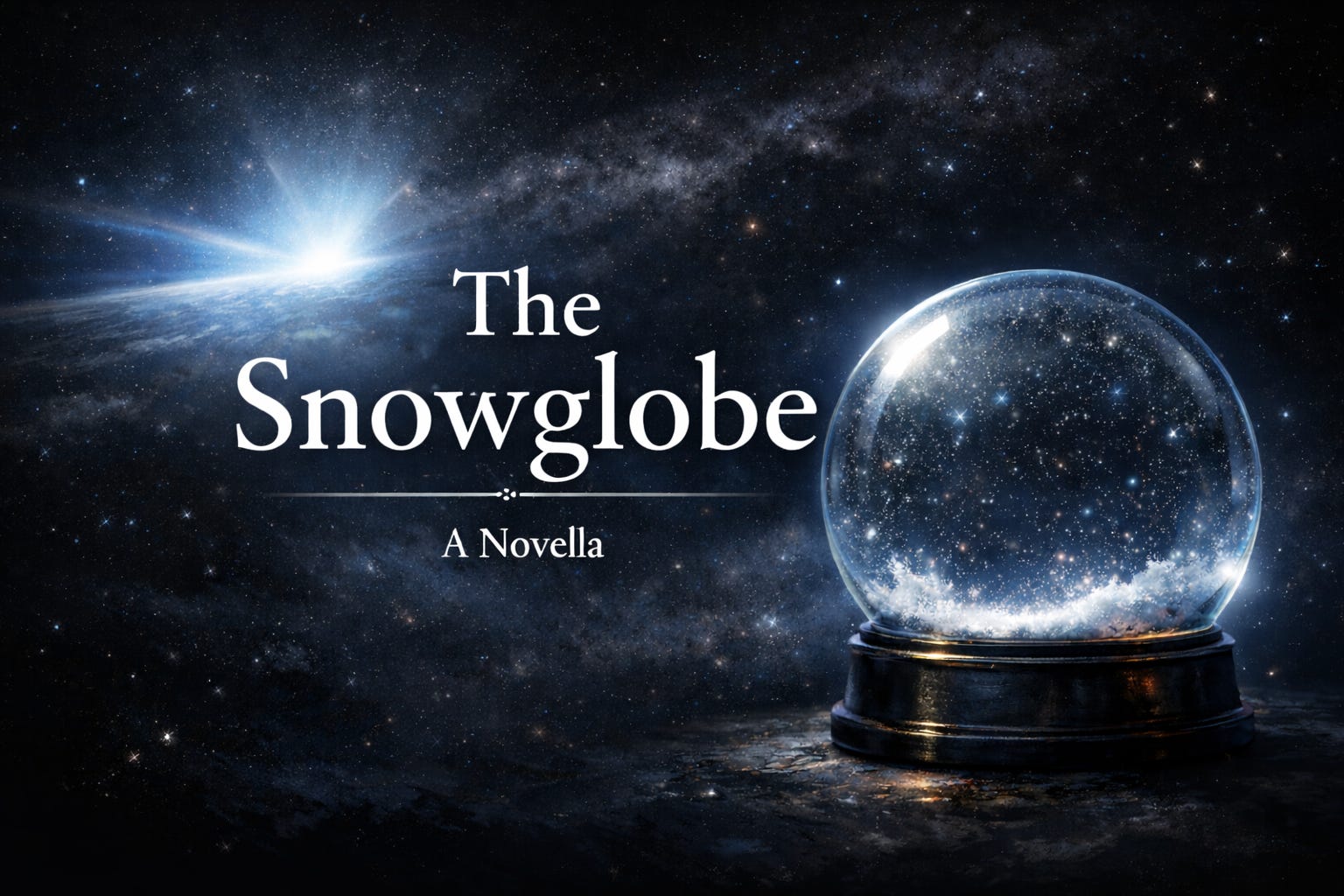
The Snowglobe: A Novella
Welcome to something a little different here on Brian’s Notebook.
You’re about to read a story about what lies beyond.
Not beyond the next election cycle or the next quarterly report—beyond the boundaries we’re told define reality itself. Beyond the edge of what everyone assumes is settled science. Beyond the place where reasonable questions are supposed to stop.
Captain James Mercer is a pilot who started noticing things. Small things at first—inconsistencies in the official story. Videos that looked wrong. Explanations that required more faith than the alternative. The kind of discrepancies that most people dismiss because the implications are too uncomfortable to consider.
But Mercer couldn’t dismiss them. The more he looked, the more the cracks showed. Until finally, he did what any reasonable person would do when they stop believing what they’re told about something fundamental.
He strapped himself into a spacecraft and launched toward the one place nobody’s supposed to look too closely.
Up.
This is science fiction, but it’s also wild, funny, and earnestly sincere. This is an allegory about truth, seeking, and what happens when someone finally looks at the world as it actually is.
What to expect:
15 chapters total (Prologue + 13 chapters + Epilogue)
Humor with genuine spiritual weight
A pilot’s perspective on impossible things
A complete story
How to read:
Each chapter is published as its own article here on Brian’s Notebook. You can use the table of contents below to bookmark chapters, or explore them as they’re shared.
If you’re here for comedy, you’ll find it. If you’re here for mystery, it’s woven throughout. If you’re here because you’re curious what happens when someone actually looks—well, that’s the whole point.
Comment if something lands. Share if you think someone else needs to read this.
Let’s find out what’s beyond.
TABLE OF CONTENTS
[The Snowglobe: A Novella]
The Snowglobe
This is a work of fiction. Names, characters, places, and incidents are either products of the author’s imagination or are used fictitiously. Any resemblance t
o actual persons, living or dead, events, or locales is entirely coincidental. This narrative is presented as allegory and entertainment, not as factual representation of scientific, historical, or theological claims.