

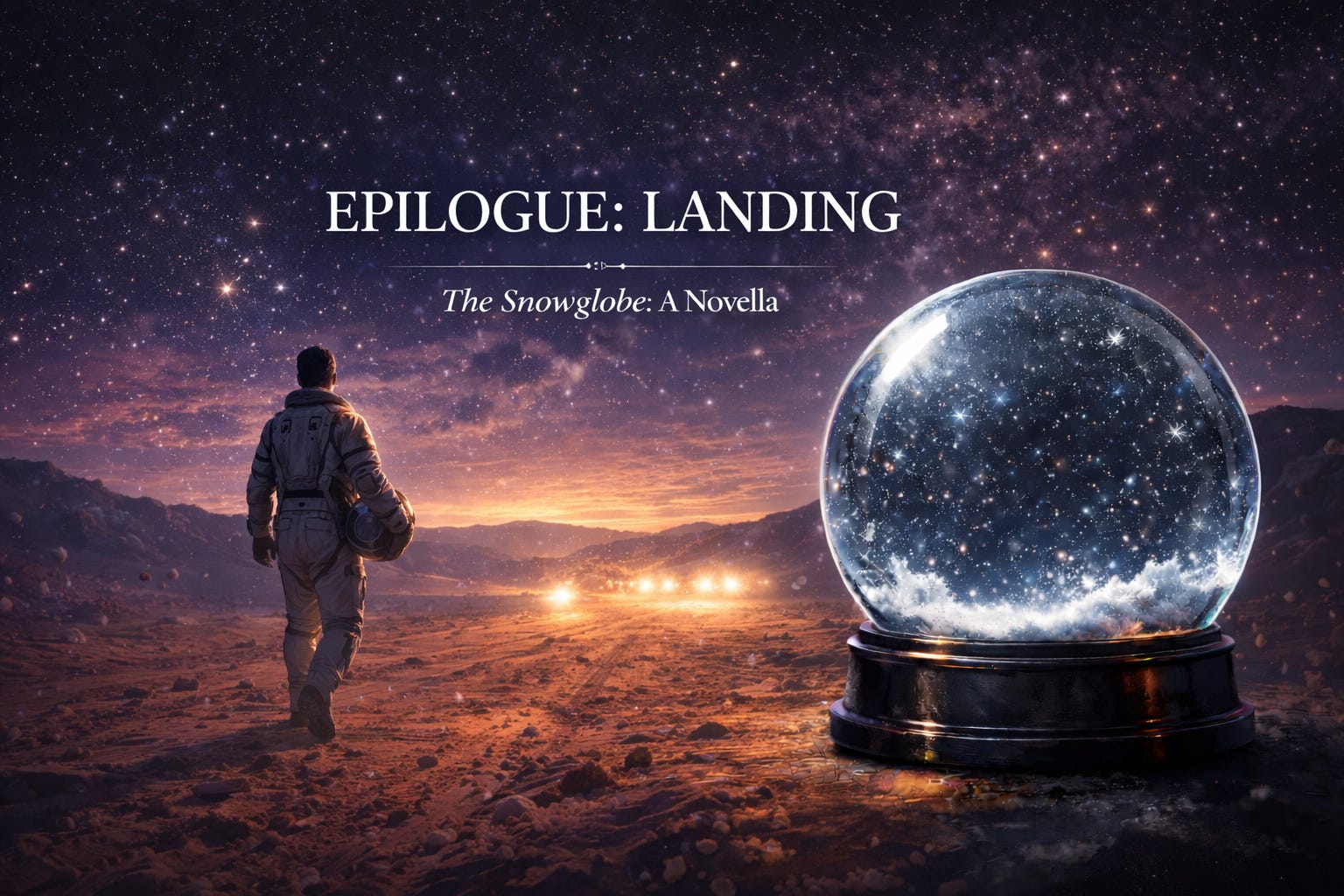
The capsule touched down in the desert, three miles from the launch facility. Not a crash. Not even a hard landing. Just a gentle settling, as if placed there by careful hands.
The hatch hissed open.
Mercer climbed out slowly, his legs unsteady not from injury but from the simple fact of gravity after weightlessness. The sand was still warm from the day’s heat, radiating it back into the cooling evening. He could smell it—that particular dryness, that particular silence.
He was alive.
Every part of him that should have been broken was whole. Every bone that should have shattered was intact. His hands didn’t shake as he steadied himself against the capsule’s frame. His breathing was even. Calm.
He looked down at his flight suit. No burns. No tears. No evidence of the impossible fall from sixty-two miles up.
In the distance, he could hear vehicles. Sirens. The sound of people coming. Sarah would be among them. The authorities. The questions. The explanations that wouldn’t explain anything.
But not yet.
For a moment, there was only the desert and the cooling sky and the weight of what he’d seen.
Mercer turned slowly, looking up.
The stars were beginning to emerge as twilight deepened. Not infinite points scattered through an endless void. Not random accidents of fusion and gravity. But lights. Attached to something. Held in place by the same hands that had caught him mid-fall.
The dome was invisible now—just the sky, just the stars, just the familiar vault of heaven that everyone saw every day without understanding what they were looking at.
He stood there, head tilted back, watching the stars come out one by one.
Waiting.
Knowing that soon he would have to speak. To testify. To tell them what he’d found beyond the lies.
But for now, he simply looked up at the ceiling of the world and remembered the voice that had caught him.
“That’s why I let you climb.”
The first vehicle crested the dune in the distance.
Mercer lowered his eyes and turned to meet them.
And back at the academy, above the auditorium exit, carved into an archway that generations had tried to chisel away, words waited in the stone. Faint. Scratched. Nearly erased.
But not quite.
The inscription had always been true. The heavens did declare the glory. The firmament did shew his handywork. Not as metaphor. Not as poetry. As fact. As physics. As the undeniable architecture of a world held together by hands that understood what human hands never could.
Mercer had climbed to prove it.
Now the proof was written in the desert sand, in the trajectory of his fall, in the voice that had caught him mid-descent.
The words carved in stone had been waiting for someone to read them and understand.
At last, someone had.
The Snowglobe
This is a work of fiction. Names, characters, places, and incidents are either products of the author’s imagination or are used fictitiously. Any resemblance to actual persons, living or dead, events, or locales is entirely coincidental. This narrative is presented as allegory and entertainment, not as factual representation of scientific, historical, or theological claims.