

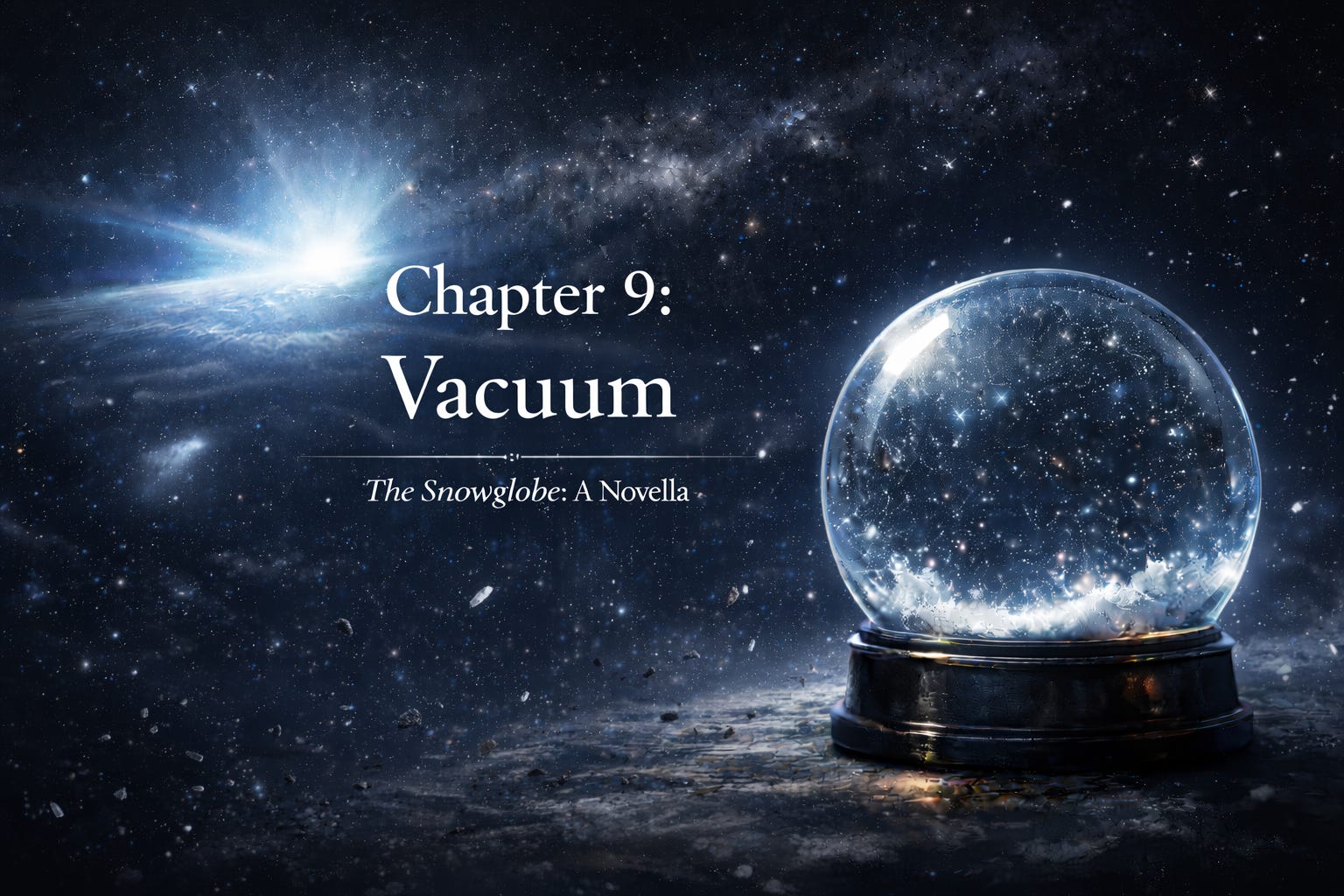
At 200,000 feet, Mercer could see it.
Not almost see it. Not sense it. Not detect it on instruments that suggested its presence.
He could see it.
The dome.
It stretched across the viewport like nothing he’d ever witnessed—a vast crystalline surface that caught and held the light of the sun in ways that made his pilot’s brain struggle for reference points. Not quite transparent. Not quite opaque. Something in between, like looking up through impossibly clear ice that had been polished to a mirror finish in some places and left frosted in others.
The stars weren’t stars.
They were lights. Embedded in the surface, or attached to it, or somehow part of its structure. Thousands of them, millions of them, arranged in the patterns that humanity had been mapping for millennia. Fixed points of light on a solid surface, exactly as they’d always appeared to be before someone had convinced everyone they were distant suns trillions of miles away.
The constellations were there. Orion. The Big Dipper. Cassiopeia. All of them, spread across the dome’s surface like decorations on a ceiling that was now close enough to see clearly.
Mercer’s hands were steady on the controls, but his breath had caught in his throat.
The altimeter read 203,000 feet. Thirty-eight miles up. The temperature gauge showed -98°F and still dropping. The radiation monitor was beeping steadily, urgently, detecting the electromagnetic field that surrounded the structure ahead.
Through the viewport, he could see where the crystalline surface flowed and joined, like veins of creation running through a unified whole. The joins were seamless, not built but grown, each transition a work of impossible artistry. The curvature was visible now—not the curvature of a planet, but the curvature of a ceiling, an enclosure, a container that arced overhead and down toward the horizons on all sides.
It was beautiful.
It was terrifying.
It was real.
Mercer checked his fuel. 22%. The number glowed on the display like a countdown timer, which, he supposed, it was.
He increased thrust slightly, climbing higher, and the memory hit him with the force of a physical blow.
It had been late. Past midnight. Sarah had been at his apartment again, surrounded by papers and open laptop files and coffee cups that had long since gone cold.
“Okay,” she’d said, rubbing her eyes. “Walk me through the atmosphere thing again. Because I keep coming back to it and it keeps not making sense.”
Mercer had pulled up a diagram. The standard model. Earth at the center, atmosphere surrounding it in layers—troposphere, stratosphere, mesosphere, thermosphere—each one getting thinner and thinner until eventually, somewhere around 60 miles up, it just... transitioned into space.
“That’s the official explanation,” he’d said. “The atmosphere doesn’t end. It just gets thinner and thinner until there’s nothing left. A gradient from something to nothing.”
“Right. Okay. That’s what they teach.”
“Now tell me what a vacuum is.”
Sarah had blinked. “A vacuum? It’s... nothing. Zero pressure. The absence of matter.”
“Exactly. Zero pressure. Not low pressure. Not thin pressure. Zero pressure. A vacuum is a vacuum. It’s absolute.”
“Okay...”
“So if space is a vacuum—true vacuum, zero pressure—and Earth’s atmosphere has pressure, about 14.7 pounds per square inch at sea level, then there has to be a boundary between them. A hard boundary. You can’t have a gradient from something to absolute nothing. That’s not how physics works.”
Sarah had stared at the diagram.
“You’re saying...”
“I’m saying a vacuum is a sucking force. It’s not passive. If you open a door between a pressurized room and a vacuum, the air doesn’t slowly drift out. It gets pulled out. Violently. Instantly. Because vacuum is the absence of pressure, and pressure always moves toward vacuum until equilibrium is reached.”
“But Earth’s atmosphere doesn’t get sucked away.”
“No. It doesn’t.”
“Because... gravity?”
Mercer had shaken his head. “Gravity doesn’t create a seal, Sarah. Gravity is a force that pulls things down. It doesn’t create a physical barrier. It doesn’t contain pressure against a vacuum. If space is truly a vacuum, and there’s no physical boundary, then gravity would have to be strong enough to hold every single air molecule against the pull of infinite nothingness.”
“And it’s not?”
“Think about it. We can create vacuums in laboratories. Small ones, in sealed containers. And what happens if the seal breaks? The air rushes in instantly. The vacuum pulls it in. Gravity doesn’t stop it. Gravity doesn’t even slow it down. Because gravity is weak compared to pressure differentials.”
Sarah had been quiet for a long moment.
“So you’re saying it’s impossible,” she’d said finally. “You’re saying Earth’s atmosphere can’t exist next to a vacuum without a physical barrier.”
“I’m saying it’s basic physics. The kind they teach in high school. Pressure moves toward vacuum. Always. Unless there’s a physical barrier preventing it.”
“A container.”
“A container.”
Sarah had looked at the diagram again. The Earth. The atmosphere. The supposed transition to space.
“They say the atmosphere is held by gravity,” she’d said slowly. “That gravity is strong enough to keep it from escaping.”
“But gravity doesn’t create a seal. It doesn’t create a boundary. It just pulls things down. And if space is a vacuum, pulling in all directions, then down doesn’t matter. The atmosphere would be pulled away in every direction at once.”
“Unless there’s a dome.”
Mercer had nodded.
“Unless there’s a dome. A physical barrier. Something solid that contains the pressure, that creates an actual boundary between atmosphere and vacuum. Something that makes it possible for air to exist at all.”
Sarah had closed her laptop.
“You’re saying the dome isn’t just there,” she’d said quietly. “You’re saying it has to be there. That basic physics requires it.”
“I’m saying it’s basic physics they hope nobody thinks about.”
She’d looked at him.
“And if you’re right...”
“Then they’ve been lying about something that makes the atmosphere itself possible. They’ve been lying about the most fundamental aspect of our existence. The air we breathe only exists because there’s a container holding it in.”
“And they’ve convinced everyone the container doesn’t exist.”
“They’ve convinced everyone that pressure can exist next to vacuum without a barrier. Which is like convincing everyone that water can be held in a bucket with no bottom.”
Sarah had laughed, but it was a hollow sound.
“Basic physics,” she’d said.
“Basic physics.”
Mercer stared through the viewport at the dome.
The physical barrier. The container. The boundary that made atmosphere possible, that made life possible, that made everything possible.
It was right there. Visible. Real. Undeniable.
The temperature gauge read -104°F. The radiation monitor was beeping faster now, more urgently. The altimeter showed 215,000 feet.
Forty miles up.
The dome was closer now. Close enough that Mercer could see details in its surface—patterns, textures, structures that suggested complexity beyond anything humanity had built. The lights that weren’t stars glowed steadily, embedded in the crystalline surface like jewels in a crown.
The sky wasn’t a sky. It was a ceiling. And he was approaching it at 800 feet per second.
Mercer checked his fuel again. 19%.
Not enough to get back down. Probably not enough to slow down significantly before impact.
But enough to reach it. Enough to touch it. Enough to prove it was real.
The lie wasn’t just about geography. It was about meaning itself.
He thought about the truth.
The dome was real. The boundary was real. The container that held the atmosphere, that made life possible, that separated the world from whatever lay beyond—it was real.
And he was going to touch it.
Mercer’s hands moved across the controls. Not to slow down. Not to turn back.
To climb higher.
The radiation monitor screamed. The temperature gauge dropped to -109°F. The altimeter read 220,000 feet.
Through the viewport, the dome filled his vision. Crystalline. Vast. Impossible.
Real.
Mercer increased thrust one more time.
The rocket climbed toward the ceiling of the world.
And the ceiling waited, patient and eternal, for him to arrive.
The Snowglobe
This is a work of fiction. Names, characters, places, and incidents are either products of the author’s imagination or are used fictitiously. Any resemblance to actual persons, living or dead, events, or locales is entirely coincidental. This narrative is presented as allegory and entertainment, not as factual representation of scientific, historical, or theological claims.