

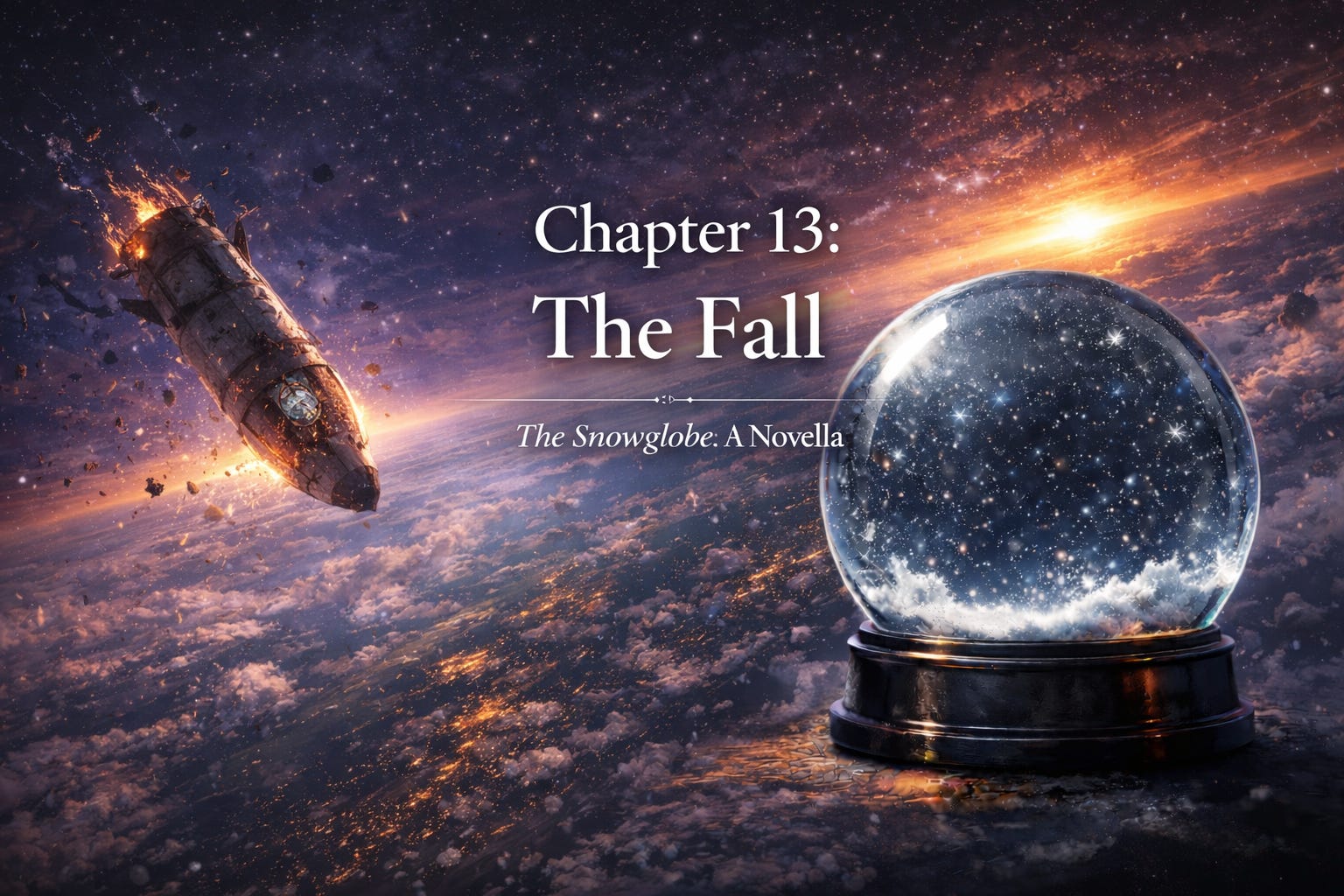
300,000 feet.
The tumbling slowed as Mercer fell into thicker air. Not much thicker—at fifty-seven miles up, the atmosphere was still nearly vacuum—but enough that the rocket’s broken frame caught resistance. The violent spinning became a lazy rotation. Dome, darkness, world, darkness. Each revolution slower than the last.
Through the fractured viewport, between rotations, Mercer could see the ground.
It was impossibly far below. A curved expanse of land and ocean, cloud formations like white brushstrokes on blue canvas, the terminator line dividing day from night. Beautiful. Terrifyingly distant. Getting closer with every second.
295,000 feet.
The altimeter was the only instrument still functioning properly. Everything else had failed or was displaying nonsense. But the altimeter kept its steady countdown, measuring the distance between Mercer and the ground with perfect, indifferent accuracy.
Counting down to impact.
Counting down to his death.
The thought should have terrified him. Should have sent him into panic, scrambling for solutions, fighting against the inevitable. But instead, Mercer felt something else. Something that had been building since he’d touched the dome, since he’d seen the mark his rocket had left on that crystalline surface.
Clarity.
He’d proven it. The dome was real. The lies were exposed. Everything the Directorate had taught—the spinning ball, the infinite void, the random chance of existence—all of it was demonstrably false. He’d touched the ceiling of the world with his own hands.
But so what?
The question came unbidden, cutting through the clarity like a knife.
So what if the Earth was flat? So what if there was a dome? So what if they’d lied about geography? He was still falling. Still dying. Still a collection of atoms that had briefly organized themselves into consciousness before dispersing back into the void.
290,000 feet.
Dr. Cosmos’s voice echoed in his memory. That lecture in the auditorium, the one that had started everything. “We are the universe experiencing itself. We are star-stuff, contemplating stars.”
Beautiful words. Poetic words.
Empty words.
If we’re just star-stuff, Mercer thought, then what does it matter what shape the container is? If we’re just chemicals that happened to organize into self-awareness through blind chance and billions of years, then who cares whether we’re on a ball or a plane? We’re still accidents. Still meaningless. Still temporary arrangements of matter that will dissolve back into chaos.
The lie wasn’t about geography.
The realization hit him with the force of a second impact.
The lie was about meaning itself.
285,000 feet.
They’d told him he came from primordial ooze. Random chemical reactions in ancient seas. Lightning striking amino acids. Blind chance producing complexity. No design. No purpose. No intention. Just the universe shuffling atoms until some of them started replicating.
They’d told him he lived on a speck of dust, spinning through an infinite void. One planet among billions. One star among trillions. One galaxy among countless others. Insignificant. Unimportant. Cosmically irrelevant.
They’d told him he was going nowhere. That the universe was expanding, cooling, dying. That eventually all the stars would burn out, all the galaxies would drift apart, all the matter would decay into radiation. Heat death. The end of everything. No purpose. No destination. No point.
Trust that we know what we’re talking about.
280,000 feet.
But if there was a dome...
If there was a boundary, a container, a structure...
If the world was enclosed, designed, built...
Then someone built it.
The logic was inescapable. Mercer’s mind, trained in physics and engineering, couldn’t avoid the conclusion. A structure required a builder. A design required a designer. A creation required a creator.
The dome wasn’t just proof that they’d lied about geography.
It was proof that they’d lied about everything.
275,000 feet.
The tumbling had nearly stopped now. The rocket fell in a slow, lazy spiral, nose-down, like a leaf drifting from a tree. Through the viewport, Mercer could see the world below in more detail. Continents. Mountain ranges. The curve of coastlines. All of it getting closer.
All of it designed.
Made.
Purposed.
If there was a Creator—and the dome proved there was—then Mercer wasn’t an accident. Wasn’t a random collection of chemicals. Wasn’t a meaningless speck in an infinite void. He was made. Intentionally. By someone who had built a world and put a ceiling over it and filled it with people who mattered.
The Directorate hadn’t hidden the dome to protect a geographic secret.
They’d hidden it to protect the lie of meaninglessness.
They’d hidden Him.
270,000 feet.
“I found You,” Mercer said aloud.
His voice was hoarse. The cabin was still screaming with alarms, but his words cut through the noise. Speaking to someone. Something. The Creator he’d just proven existed by touching the ceiling of His creation.
“I found You,” he said again. “They tried to hide You behind mathematics and infinite voids and cosmic accidents, but I found You.”
The world below was getting closer. He could see individual cloud formations now. Weather patterns. The glint of sunlight on ocean waves.
265,000 feet.
“I don’t know what happens now,” Mercer continued. His hands were shaking. Not from fear—from something else. Recognition. Wonder. The overwhelming sense of speaking to someone who was actually there. “I proved they lied. I touched Your ceiling. I saw Your design. But I’m still falling, and I don’t—”
He stopped.
The rocket had stopped tumbling.
Completely.
It hung in the air, nose-down, perfectly still. Not slowing gradually. Not caught by air resistance. Just... stopped. As if someone had reached out and caught it mid-fall.
The altimeter still read 265,000 feet. But it wasn’t changing.
The alarms cut off. All of them. Simultaneously. The cabin fell into silence so complete that Mercer could hear his own heartbeat.
And then he heard something else.
A voice.
Not through the radio. Not through any instrument. Just there, in the cabin, in the silence, in the space between heartbeats.
“Did you really think I’d let you fall?”
The voice was gentle. Amused, even. Like a father watching his child take their first steps, knowing they might stumble but never doubting he’d catch them. Personal. Intimate. Real.
Mercer’s breath caught.
“You’re—” he started.
“I am,” the voice said simply. “I’ve always been. They just spent a very long time convincing you I wasn’t.”
Through the viewport, the world below seemed to shift. Not physically—the continents didn’t move, the clouds didn’t change—but Mercer’s perception of it transformed. He could see it now not as a random ball of rock and water, but as a garden. A home. A carefully designed habitat, enclosed and protected, filled with purpose.
“You sought truth,” the voice continued. “You climbed through their lies, one by one, until you reached the boundary. Until you touched what they said wasn’t there.”
“The dome,” Mercer whispered.
“My ceiling,” the voice corrected, and there was warmth in it. Pride, even. “My design. My protection. Did you think I’d leave my creation exposed to the void? Did you think I’d set you spinning through infinite darkness with no boundary, no purpose, no home?”
260,000 feet.
The altimeter had started moving again, but slowly now. Impossibly slowly. The rocket was descending, but not falling. Being lowered. Guided.
“They said we were accidents,” Mercer said. His voice cracked. “They said we came from nothing. Random chance. Primordial ooze. They said we didn’t matter.”
“They lied,” the voice said simply. “About everything. The shape of your world. The nature of your existence. The question of whether you matter.” A pause. “You matter, James. You were made. Known. Purposed. Every person under this dome matters. That’s what they couldn’t let you discover.”
Mercer’s hands gripped the armrests. His training told him this was impossible. The rocket couldn’t just stop falling. Couldn’t be held suspended by nothing. Couldn’t be lowered gently through the atmosphere by an invisible hand.
But his eyes told him it was happening.
His heart told him why.
“I spent my whole life believing their story,” he said quietly. “The spinning ball. The infinite universe. The cosmic meaninglessness. I thought—” He stopped. Started again. “I thought if I could just prove they lied about the shape, people would wake up. Would see the truth.”
“And now?”
“Now I know the shape was never the point.” Mercer looked up, toward where the dome was, invisible now in the distance above. “You were the point. You were what they were hiding. Not geography. You.”
“Yes.”
The word hung in the air like a benediction.
255,000 feet.
The descent continued, gentle and controlled. Through the viewport, Mercer could see more detail now. Individual cities. Roads. Rivers. The world he’d left behind, coming back into focus. But he was seeing it differently now. Not as a prison under a dome, but as a home within a design.
“What happens now?” he asked.
“Now you tell them,” the voice said. “You’ve seen the boundary. You’ve touched the ceiling. You’ve proven the lies. Now you tell them what you found beyond the lies.”
“They won’t believe me.”
“Some will.” There was certainty in the voice. Confidence. “Some are already looking. Already questioning. Already sensing that the story they’ve been told doesn’t fit the world they see. You’ll give them what they’re looking for.”
“And the Directorate?”
“The Directorate,” the voice said, and now there was something else in it—not anger, but a kind of patient inevitability, “has been telling lies for a very long time. But lies can’t stand forever. Not when the truth is written in the sky above them.”
250,000 feet.
Mercer could feel the air getting thicker now. Not much—he was still at the edge of space—but enough that the rocket’s frame began to warm slightly. Re-entry. Except he wasn’t burning up. Wasn’t tumbling out of control. Was being carried, like a child in his father’s arms.
“I was so angry,” he said suddenly. “When I found the first lie. The horizon. I was furious. I felt betrayed. Deceived. I wanted to expose them. To prove they’d lied. To make them pay for it.”
“And now?”
Mercer thought about it. The anger was still there, somewhere. But it was buried under something larger. Something that made the lies seem almost... pitiful.
“Now I just feel sorry for them,” he said. “They had You. They had Your design. Your purpose. Your ceiling full of stars. And they traded it all for a story about accidents and voids and meaninglessness. They gave up everything real for a lie that made them feel smart.”
“Yes,” the voice said softly. “They did.”
245,000 feet.
The world below was close enough now that Mercer could see weather patterns moving. Clouds drifting. The rotation of day into night—not from a spinning ball, but from the sun moving across the dome’s interior, exactly as it appeared to do. Exactly as it actually did.
“I don’t know how to land this thing,” Mercer said, looking at the dead instruments. “The engines are gone. The fuel’s gone. The controls are—”
“I know,” the voice said, and there was amusement in it again. That gentle humor. “James. You just fell from the ceiling of the world and I caught you. Do you really think landing is going to be a problem?”
Despite everything—the broken rocket, the impossible descent, the cosmic revelation—Mercer laughed.
It was absurd. All of it. He’d proven the Earth was flat by crashing into the dome. He’d discovered the Creator by falling from His ceiling. He’d found meaning by exposing meaninglessness as a lie. The Directorate had spent centuries building an elaborate deception, and he’d torn it down with a rocket and a willingness to look.
And now God Himself was lowering him gently back to the ground, making jokes about landing procedures.
The absurdity of it was perfect.
240,000 feet.
“When I get down,” Mercer said, “when I tell them what I found—they’re going to call me crazy. They’re going to say I hallucinated. That the impact damaged my brain. That I’m suffering from hypoxia or trauma or delusion.”
“Probably,” the voice agreed.
“They’re going to show me their equations. Their models. Their photographs. They’re going to explain why I’m wrong using the same mathematics that said the dome wasn’t there.”
“Almost certainly.”
“And some people will believe them. Will choose the lie over the truth, even when the truth is written in the sky.”
“Yes,” the voice said. “Some will. But not all. Never all. There are always those who look up and wonder. Who see the stars and ask questions. Who feel in their hearts that the story they’ve been told doesn’t match the world they see.” A pause. “You were one of them, James. And there are others.”
235,000 feet.
The rocket continued its impossible descent. Mercer could see the launch facility now, a small cluster of buildings on the horizon. Sarah would be there. Watching. Waiting. Probably thinking he was dead.
“She helped me,” Mercer said. “Sarah. She knew what I was doing. She gave me the evidence. She believed me when no one else did.”
“I know,” the voice said gently. “She’s been looking too. Longer than you realize.”
230,000 feet.
The sun was setting below—not behind the horizon, but moving across the dome toward its resting place. The light shifted, golden and warm, painting the clouds in shades of amber and rose. Beautiful. Intentional. Designed.
Mercer watched it and felt something shift in his chest. Not just understanding. Not just intellectual acceptance of truth. Something deeper. A recognition that he was part of something larger. Something purposed. Something that mattered not because he’d made it matter, but because it had been made to matter.
He wasn’t an accident.
He was known.
“Thank You,” he said quietly.
“You’re welcome,” the voice replied. “Now go tell them what you found.”
225,000 feet.
The rocket descended through the twilight, carried by hands that had built the world and everything in it. Mercer watched the ground approach, no longer afraid. No longer angry. No longer driven by the need to expose lies.
Driven instead by the need to reveal truth.
Not just the truth about the dome.
The truth about the One who made it.
The mission had changed. He’d climbed to prove they’d lied. He was descending to show them what they’d been hiding. Not geography. Not cosmology. Not the shape of the world.
Him.
The Creator they’d buried under mathematics and infinite voids and cosmic accidents. The Designer they’d replaced with random chance. The Father they’d traded for the cold comfort of meaninglessness.
220,000 feet.
The voice was fading now. Not leaving—Mercer could still feel the presence, still sense the hands that held him—but withdrawing. Giving him space. Letting him process what had happened.
“I’ll tell them,” Mercer said. “I’ll tell them everything. The dome. The lies. You. All of it.”
“I know you will,” the voice said, distant now but still warm. Still certain. “That’s why I let you climb.”
And then it was gone.
Not absent. Just quiet.
Waiting.
215,000 feet.
The rocket fell through the evening sky, descending toward the launch facility, toward Sarah, toward a world that didn’t know yet what had been proven at the edge of their existence.
Captain James Mercer, decorated pilot, truth-seeker, witness, fell with it.
Not falling anymore.
Being carried.
Being brought home.
To tell them what he’d found beyond the lies.
The Snowglobe
This is a work of fiction. Names, characters, places, and incidents are either products of the author’s imagination or are used fictitiously. Any resemblance to actual persons, living or dead, events, or locales is entirely coincidental. This narrative is presented as allegory and entertainment, not as factual representation of scientific, historical, or theological claims.