

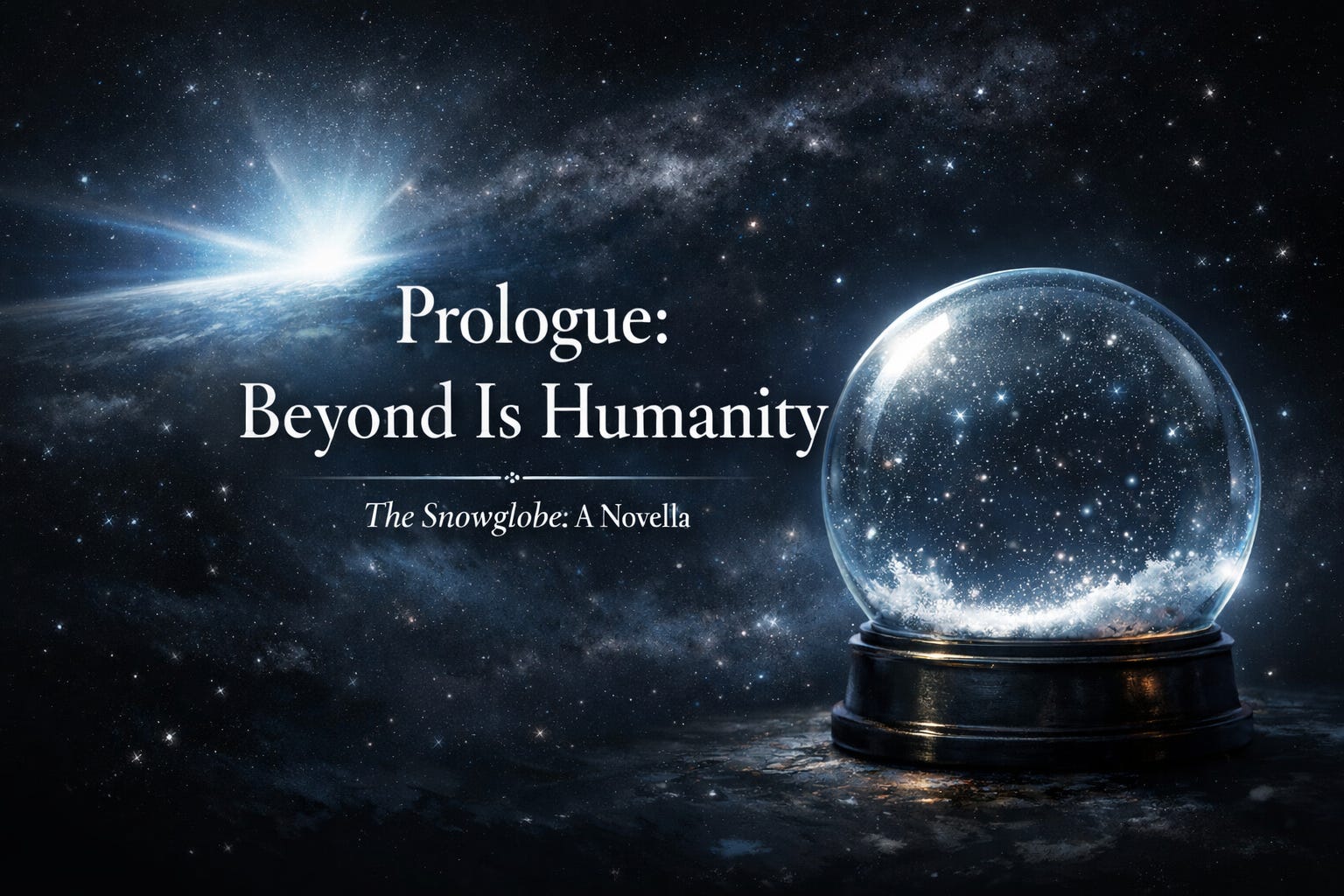
The Snowglobe
This is a work of fiction. Names, characters, places, and incidents are either products of the author’s imagination or are used fictitiously. Any resemblance to actual persons, living or dead, events, or locales is entirely coincidental. This narrative is presented as allegory and entertainment, not as factual representation of scientific, historical, or theological claims.
The auditorium held three hundred souls, and Dr. Helios Cosmos owned every single one of them.
He stood center stage beneath a holographic projection of the solar system, arms spread wide like a conductor before an orchestra, his silver hair catching the light in a way that suggested either excellent genetics or excellent product placement. Possibly both. His lab coat—because of course he wore a lab coat, white and pristine and utterly unnecessary for a lecture—billowed slightly in the breeze from the stage fans.
Yes, there were stage fans.
Dr. Cosmos believed in presentation.
“LOOK UP!” he shouted, and three hundred faces tilted obediently toward the ceiling, where the hologram had expanded to show a blue marble suspended in black space. “What do you see?”
“Earth!” someone called out.
“HOME!” shouted another.
“A SPINNING BALL OF ROCK HURTLING THROUGH THE VOID AT SPEEDS THAT WOULD MAKE YOUR ANCESTORS WEEP!” Dr. Cosmos swept his arm in a grand arc, and the holographic Earth began to rotate. “You are standing—right now, at this very moment—on a sphere that is spinning at ONE THOUSAND MILES PER HOUR!”
He paused for effect. The audience gasped appreciatively.
A young cadet in the third row raised her hand tentatively. “But... we don’t feel it spinning.”
Dr. Cosmos beamed at her like she’d just asked the meaning of life. “EXACTLY! You don’t feel it because you, my dear, are moving WITH it! You and this auditorium and this entire facility and everyone you’ve ever loved are all spinning together at one thousand miles per hour, and you don’t feel a thing! Isn’t that MAGNIFICENT?”
The audience applauded. The cadet looked pleased with herself.
Behind Dr. Cosmos, the hologram shifted. Now the Earth was orbiting a sun, tracing a glowing elliptical path through the darkness.
“But wait!” Dr. Cosmos spun on his heel, his coat flaring dramatically. “It gets BETTER! Not only are you spinning at a thousand miles per hour, you are ALSO orbiting our glorious sun at—” He paused, building tension. “—SIXTY-SIX THOUSAND, SIX HUNDRED MILES PER HOUR!”
More gasps. Someone in the back whispered, “That’s impossible.”
Dr. Cosmos heard it. He always heard it. His smile widened.
“Impossible? IMPOSSIBLE?” He laughed, a rich sound that filled the auditorium. “My friend, you are living the impossible! Right now, as you sit in that chair, you are moving at speeds that would turn you into paste if you hit anything! But you don’t hit anything, because SPACE—” he gestured grandly at the hologram “—is very, very empty!”
The hologram zoomed out further. Now the entire solar system was visible, and it was moving—sliding through a river of stars like a boat on a current.
“And just when you think it can’t get more incredible,” Dr. Cosmos said, his voice dropping to a stage whisper that somehow carried to the back row, “just when you think you’ve grasped the sheer audacity of your existence... you discover that our entire solar system is moving through the galaxy at FIVE HUNDRED AND FOURTEEN THOUSAND MILES PER HOUR!”
Silence.
Then, from somewhere in the middle rows: “I think I’m going to be sick.”
Laughter rippled through the audience. Dr. Cosmos grinned.
“You’re not sick, cadet. You’re ENLIGHTENED! You have just learned that you are a passenger on the fastest, most improbable ride in the universe, and you didn’t even need to buy a ticket!”
He snapped his fingers. The hologram changed again, this time showing a murky green ocean, primitive and lifeless. Lightning flashed across the ancient sky.
“Now,” Dr. Cosmos said, his tone shifting to something almost reverent, “let me tell you the most beautiful part. The part that makes all of this—” he gestured at the spinning, hurtling, impossible cosmos above them “—even more miraculous.”
He walked to the edge of the stage, close enough that the cadets in the front row could see the gleam in his eyes.
“Four billion years ago, there was nothing. No humans. No consciousness. No purpose. Just chemicals in a soup, mixing randomly, meaninglessly, without direction or design.” He paused. “And then, by pure chance—by the most improbable accident in the history of accidents—those chemicals became something more. They became life.”
The hologram showed single-celled organisms, then fish, then amphibians crawling onto land, then mammals, then primates, then—
“You,” Dr. Cosmos said softly. “You are the product of four billion years of random mutations and survival of the fittest. You are an accident that learned to think. A cosmic fluke that learned to dream.”
He let that sink in for a moment.
Then his voice rose again, filling the auditorium with renewed energy. “And yet! AND YET! Despite being accidents, despite being flukes, despite being nothing more than animated stardust with delusions of grandeur—YOU ARE DESTINED FOR GREATNESS!”
The hologram exploded into a vision of the future: gleaming spacecraft, colonies on Mars, humans walking on distant worlds beneath alien suns.
“BEYOND IS HUMANITY!” Dr. Cosmos shouted, echoing the slogan on the massive poster behind him—a heroic astronaut planting the Directorate flag on red soil. “You came from nothing! You are going to EVERYTHING! From the primordial ooze to the stars themselves! This is your destiny! This is your PURPOSE!”
The audience was on its feet now, applauding, cheering. Three hundred faces shining with belief, with hope, with the absolute certainty that they were part of something greater than themselves.
Dr. Cosmos basked in it for a moment, then raised his hands for silence.
“The Directorate,” he said, his voice warm and paternal, “exists to guide you on this journey. To help you reach your potential. To ensure that humanity fulfills its destiny among the stars.” He smiled. “Trust in the Directorate. Trust in the science. Trust in the numbers.”
He gestured at the hologram one final time—Earth spinning, orbiting, hurtling through space at impossible speeds that no one could feel.
“Trust,” he said quietly, “that we know what we’re talking about.”
The lights came up. The hologram faded. Dr. Cosmos took a bow to thunderous applause.
In the back row, a young man with dark hair and serious eyes clapped along with everyone else. His name was James Mercer, and he was seventeen years old, and he believed every single word he’d just heard.
As the cadets filed out of the auditorium, chattering excitedly about spinning planets and evolutionary destiny, none of them noticed the small inscription carved into the archway above the exit. It was old—older than the Directorate, older than the academy, older than anyone could remember.
It was written in a language that had been officially declared extinct.
Translated, it read: “The heavens declare the glory...; and the firmament sheweth... handywork.”
Someone had tried to chisel it away once, long ago.
They hadn’t quite managed all of it.
The words remained, faint but legible, waiting for someone to read them.
Waiting for someone to wonder why they’d been hidden in the first place.
The Snowglobe
This is a work of fiction. Names, characters, places, and incidents are either products of the author’s imagination or are used fictitiously. Any resemblance to actual persons, living or dead, events, or locales is entirely coincidental. This narrative is presented as allegory and entertainment, not as factual representation of scientific, historical, or theological claims.