

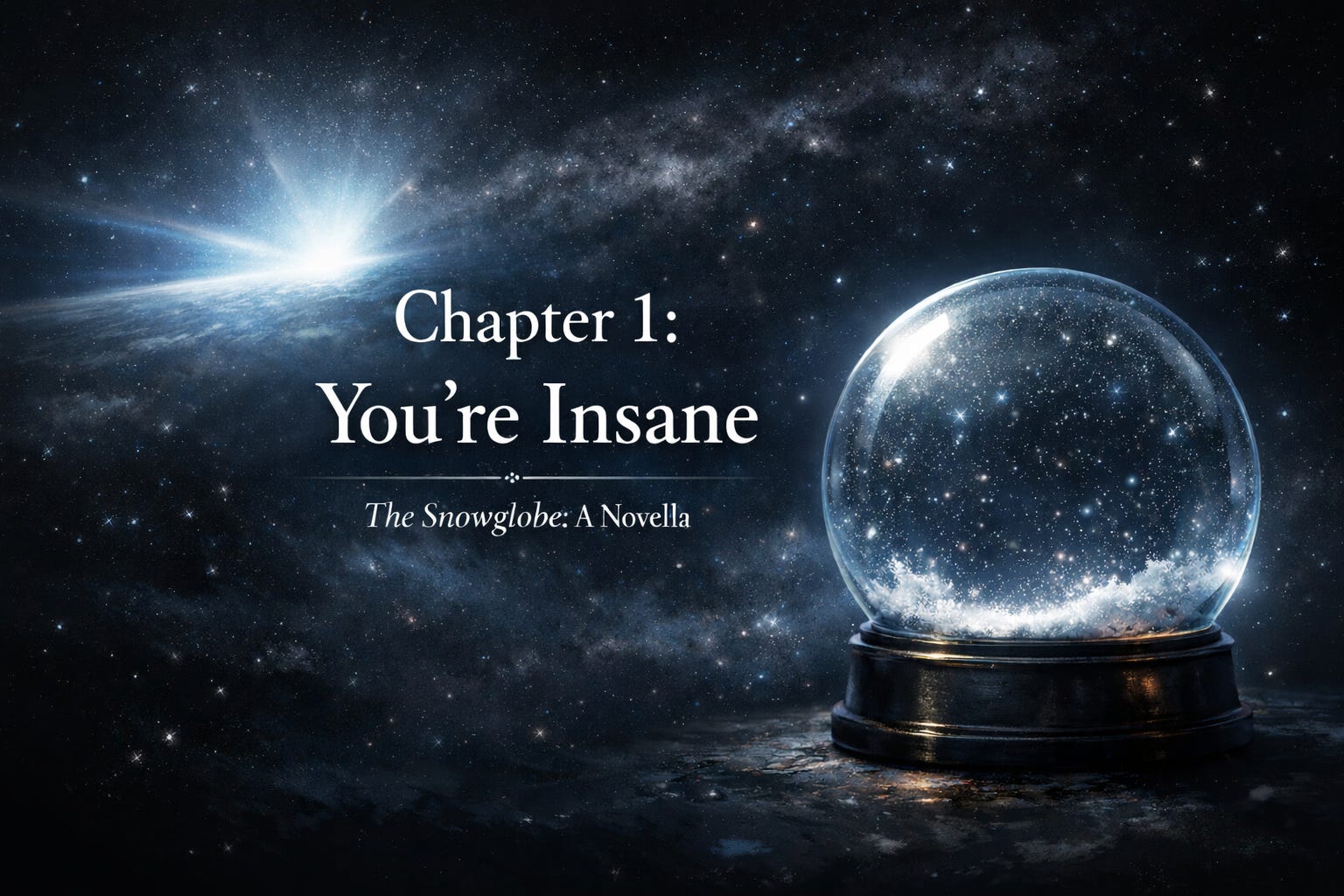
“You’re insane,” said Dr. Sarah Chen, not for the first time.
Captain James Mercer stood at the observation window of Launch Control Station Seven, watching the rocket gleam under the floodlights. The single-stage experimental rocket sat vertical on its pad, gantry arms embracing it like skeletal fingers, fuel vapor venting in ghostly wisps from the cryogenic systems. Pre-dawn darkness pressed against the reinforced glass, making the launch facility look like an island of light in an ocean of nothing.
Officially, the rocket was designed to study atmospheric conditions at extreme altitudes. Unofficially—well, Mercer had his own theories about what it was really designed to study.
Or rather, what it was designed to avoid studying.
“You’ve mentioned that,” he said, not looking away from the rocket.
“I’m mentioning it again.” Sarah’s reflection appeared in the glass beside his. Behind them, the control station was empty—she’d made sure of that, pulling strings and calling in favors and disabling just enough security protocols to give him a window. Twenty minutes, maybe less. “You have a PhD in atmospheric physics. You’re the Directorate’s most decorated pilot. You have a career, a reputation, a future—”
“Had,” Mercer corrected quietly. “Past tense. The moment I filed that report about the Van Allen discrepancies, my future became very much past tense.”
Sarah flinched. They both knew he was right. The “informal counseling session” with Directorate Security had made that abundantly clear. As had the sudden reassignment to “administrative duties pending psychological evaluation.”
As had the not-so-subtle suggestion that he seek “voluntary treatment” at the Directorate Wellness Center, which everyone knew was where inconvenient people went to become convenient again.
“James.” Sarah’s voice dropped to barely a whisper, even though the control room was empty. Even though she’d personally disabled the monitoring systems. Even though she’d given him the override codes that would let him launch a fifty-million-credit rocket without triggering any alarms until it was far too late to stop him.
Even though she was, technically, helping him commit treason.
“What if you’re wrong?” she asked.
Mercer finally turned to look at her. Sarah Chen had been his friend for eight years, his colleague for twelve, and the only person in the entire Directorate who’d listened—really listened—when he’d started noticing things that didn’t add up. She’d reviewed his data. She’d checked his math. She’d even looked at some of the forbidden materials he’d found in that dusty bookshop in the old quarter.
She hadn’t believed him. But she’d looked.
That was more than anyone else had done.
“What if I’m right?” he countered.
“Then you’re going to launch straight up until you hit a giant crystalline dome that’s been hiding the truth about reality for the entire history of human civilization, and then what? You take a selfie? You come back down and show everyone? They already think you’re crazy, James. This isn’t going to help.”
“I don’t need to convince everyone,” Mercer said quietly. “I just need to know. For myself. I need to see it.”
“Why?”
It was a good question. Maybe the best question. Why risk everything—career, freedom, possibly his life—just to confirm what he already believed in his heart?
Mercer thought about the water that always found its level, no matter how high you went. The horizon that stayed stubbornly at eye level even at sixty thousand feet. The stars that moved in perfect synchronization, like lights on a ceiling rather than distant suns. The rockets that always, always curved back to horizontal, no matter how much thrust they generated or how many times they redesigned the trajectory.
The Van Allen Belts that shouldn’t exist if the Ares missions had really passed through them.
The Blue Marble photographs that were officially, admittedly, “photoshopped composites because they have to be.”
The old texts he’d found, the forbidden books that spoke of a firmament, a dome, a Creator who’d made the world with love and purpose and protection.
“Because if it’s true,” he said finally, “then everything changes. We’re not accidents, Sarah. We’re not cosmic dust that happened to coalesce into consciousness. We’re not alone in an infinite, uncaring universe. We’re...” He struggled for the words. “We’re loved. We’re known. We’re home.”
Sarah’s eyes were bright with tears. “Or you’re about to die proving that you’ve lost your mind.”
“That’s a risk I’m willing to take.”
“Well, I’m not willing to watch you take it.” She pulled a small device from her pocket—a data recorder, military grade. “Your telemetry will be recorded on this. If you’re right, if there’s something up there, this will capture it. And if you’re wrong...” She swallowed hard. “If you’re wrong, at least we’ll have proof that you went looking for truth, not running from reality.”
Mercer took the recorder, their fingers touching briefly. “Thank you.”
“Don’t thank me. I’m enabling your suicide mission.” But she was smiling, just a little. “You have eighteen minutes before the shift change. After that, all bets are off. The override codes will get you through the automated launch sequence, but once you initiate ignition, there’s no abort. No coming back. Just up.”
“Eighteen minutes to reach the edge of everything and prove that everything we’ve been taught is a lie.” Mercer pocketed the recorder. “No pressure.”
“James.” Sarah’s hand caught his arm, stopping him from turning toward the door. “What if you do find it? What if there really is a dome up there? What then?”
Mercer looked at her, this brilliant woman who’d risked everything to help him chase what everyone else called madness. “Then I’ll know,” he said simply. “I’ll know that someone made this place. That we’re not accidents. That there’s a reason for all of this.” He gestured vaguely at the control room, the launch facility, the world beyond. “That we matter.”
Sarah nodded slowly. Her hand fell away.
“Launch safe, Captain.”
“I’m launching straight up into a dome that may or may not exist,” Mercer said. “I don’t think ‘safe’ is really on the table.”
Through the observation window, he saw her laugh despite herself. Then he was moving toward the door, toward the gantry elevator, toward the point of no return.
The walk across the launch pad felt longer than it should have. Floodlights turned the night into artificial day, casting harsh shadows from the gantry structure. The rocket loomed above him, white and gleaming, fuel vapor still venting in rhythmic pulses. The smell of rocket propellant hung in the air—sharp, chemical, dangerous.
The elevator ride up the gantry was silent except for the hum of machinery and the distant sound of cryogenic pumps. Through the metal lattice, Mercer could see the world falling away—the launch facility, the perimeter fence, the dark landscape beyond. The sky above was still black, stars visible and fixed and waiting.
At capsule level, the gantry platform swayed slightly in the wind. Mercer stepped across the access bridge, his hand trailing along the rocket’s hull. The metal was cold, almost painfully so, frosted with condensation from the super-cooled fuel inside.
The capsule hatch stood open. Beyond it, the command seat waited, surrounded by displays and controls and systems designed to take a human being to altitudes that humans were never meant to reach.
Mercer climbed inside.
The capsule was cramped, efficient, designed for function rather than comfort. He strapped himself into the command seat, the harness clicking into place with mechanical precision. The viewport above showed a circle of sky, stars visible through the gantry structure. Around him, displays flickered to life as the systems recognized his presence.
He pulled out the data recorder Sarah had given him, mounted it to the console. Then he accessed the launch control interface, fingers moving across the touchscreen with practiced efficiency.
The override codes Sarah had provided unlocked systems that should have required three separate authorizations and a direct order from Directorate Command. One by one, the launch sequence protocols activated. Fuel pressurization: nominal. Engine systems: online. Guidance computer: accepting commands.
Launch authorization: approved.
Through the capsule’s external cameras, Mercer could see the gantry arms beginning to retract, pulling away from the rocket’s hull with hydraulic precision. The launch tower was already moving, the massive structure rolling back on its rails, clearing the path to the sky.
Mercer’s hands were steady on the control interface.
His heart was pounding.
And somewhere in the back of his mind, a voice he’d been hearing more and more lately—a voice from dreams, from the forbidden texts, from somewhere beyond the world he knew—whispered: Come and see.
“All right,” Mercer said to himself, to Sarah watching from the control station, to the voice, to whatever was waiting for him up there in the sky. “Let’s see what’s really up there.”
He initiated the ignition sequence.
For a moment, nothing happened.
Then the world became fire and thunder.
The main engines ignited with a roar that shook the capsule, that shook the earth, that seemed to shake reality itself. G-forces slammed Mercer back into his seat as the rocket lifted, slowly at first, then faster, then impossibly fast. The gantry structure fell away. The launch facility became a point of light. The ground became a memory.
The rocket erupted skyward like a prayer made of fire and fury and desperate hope.
And Captain James Mercer, decorated pilot and certified madman, went looking for the face of God.
The Snowglobe
This is a work of fiction. Names, characters, places, and incidents are either products of the author’s imagination or are used fictitiously. Any resemblance to actual persons, living or dead, events, or locales is entirely coincidental. This narrative is presented as allegory and entertainment, not as factual representation of scientific, historical, or theological claims.